Anthropic: cómo se pone precio a una salida a bolsa de 60.000 millones
Anthropic fijará este miércoles el precio de la segunda mayor salida a bolsa de la historia. Antes de que empiece a cotizar, conviene mirar cómo se decide ese número y quién se queda con las acciones.
El jueves 19 de noviembre, si no hay cambios, Anthropic empezará a cotizar en el Nasdaq con el símbolo ANT. La empresa que desarrolla Claude quiere vender 825 millones de acciones a entre 70 y 78 dólares cada una, lo que supone captar hasta 64.350 millones de dólares. Solo SpaceX, que levantó 75.000 millones en junio, ha hecho una operación más grande.
Del negocio de Anthropic se ha escrito mucho estas semanas. A mí me interesa más otra cosa, que es cómo se llega a un precio para una empresa que nunca ha cotizado. Ese trabajo lo hacen los bancos de inversión, y esta operación enseña bastante bien cómo funciona.
Qué se vende y a qué precio
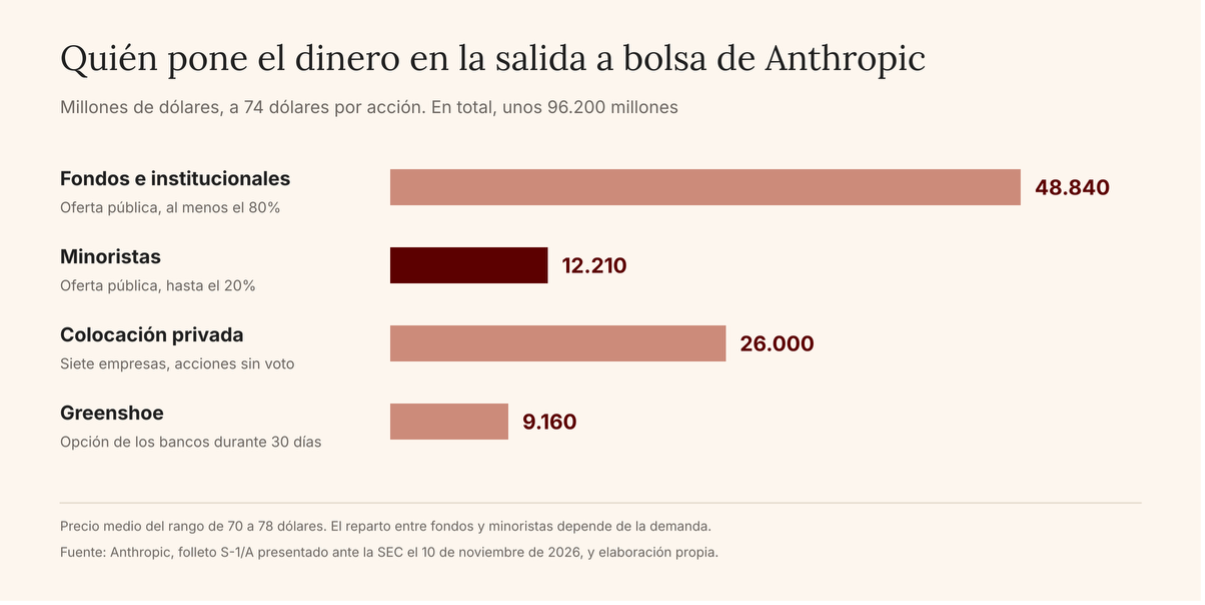
El folleto, registrado ante la SEC el 26 de octubre y actualizado el 10 de noviembre, recoge una oferta de 825 millones de acciones de clase A. De ellas, 801,4 millones son nuevas y el dinero va a la empresa. Las otras 23,6 millones las venden accionistas actuales, así que Anthropic no ingresa nada por ellas. Al precio medio del rango, 74 dólares, la oferta suma 61.050 millones.
A la vez hay una colocación privada de 26.000 millones. Siete empresas comprarán acciones de clase N, sin derecho a voto, al mismo precio que salga de la oferta: Google y Nvidia ponen unos 10.000 millones cada una, AMD 2.500, Broadcom, Micron y Microsoft 1.000 cada una y TSMC 500. Son empresas de chips y de nube con las que Anthropic ya trabaja.
Además, si la demanda acompaña, los bancos pueden vender otros 123,75 millones de acciones, lo que se conoce como greenshoe. Sumando las tres partes, y siempre a 74 dólares, la operación se acerca a los 96.200 millones.
Con la valoración hay que tener cuidado, porque circulan dos cifras. Si se multiplica el precio por los 13.087 millones de acciones que habrá tras la operación, Anthropic vale entre 916.000 millones y 1,02 billones de dólares. Otros medios hablan de entre 1,26 y 1,41 billones porque cuentan también las opciones y las acciones que todavía no se han emitido, lo que se llama valoración fully diluted. Las dos están bien calculadas, pero no se pueden comparar entre sí. En cualquier caso, quedan lejos de los 2 billones de los que se hablaba hace unos meses.
Cómo se llena el libro
El rango de 70 a 78 dólares no es el precio, es el punto de partida. Desde el 10 de noviembre la dirección de Anthropic está de roadshow, es decir, presentando la empresa a los grandes inversores. Cada uno dice cuántas acciones quiere y hasta qué precio está dispuesto a pagar, y los bancos lo van apuntando en el libro de órdenes. A este proceso se le llama bookbuilding.
En la operación participan 22 bancos. Los dos primeros de la portada del folleto son Goldman Sachs y Morgan Stanley, y Goldman ocupa la posición de la izquierda, el lead left, que suele ser quien coordina el libro y el reparto de acciones.
Según Reuters, el primer día el libro ya cubría dos veces la oferta y el tercero unas seis. Son cifras de prensa, porque Anthropic no ha publicado ninguna. El Financial Times ha contado además que los bancos estudian fijar el precio por encima de los 78 dólares, lo que, según el diario, llevaría la valoración fully diluted a 1,5 billones o más.
Una demanda de seis veces no significa que la acción valga seis veces más. Los inversores saben que les van a recortar la orden y piden de más. Con ese libro delante, el banco tiene que elegir. Si pone el precio alto, la empresa ingresa más dinero el día de la colocación. Si lo pone algo más bajo, la acción sube el primer día y los inversores quedan contentos, pero esa subida es dinero que la empresa ha dejado de ingresar. Según el mismo periódico, Anthropic prefiere ahora captar el máximo posible antes que presumir de valoración.
Quién se lleva las acciones
Con un libro seis veces mayor que la oferta, la mayoría de los inversores va a recibir menos de lo que pidió. El reparto lo deciden los bancos junto con la empresa, y lo habitual es premiar a quien se espera que mantenga la acción y no a quien la va a vender el primer día. Bloomberg ha publicado que los accionistas actuales tendrán prioridad.
Lo menos habitual de esta operación es el peso del pequeño inversor. El folleto dice que hasta un 20% de las acciones puede ir a minoristas, según la demanda. Para comparar, Arm reservó en torno a un 10% en 2023 e Instacart hasta un 5%. SpaceX ya hizo lo mismo que Anthropic en junio.
En Estados Unidos el tramo minorista se vende a través de plataformas como Charles Schwab, Fidelity o Robinhood. En Europa hay un folleto específico para nueve países, entre ellos España, con un máximo de 80,1 millones de acciones. Aquí se puede pedir hasta el miércoles 18 a las 16:00 en brókeres como Trade Republic, eToro o Revolut, sin saber todavía el precio final ni cuántas acciones se van a recibir.
A 74 dólares, ese 20% equivale a unos 12.200 millones. Parece mucho, pero es más o menos la octava parte de todo lo que se va a captar. El grueso lo ponen los fondos y las siete empresas de la colocación privada.
Que haya tanto minorista le viene bien a quien vende. Un particular suele fijarse menos en el precio que un fondo, así que su demanda ayuda a colocar la acción en la parte alta del rango. Para quien compra, eso mismo deja menos margen de subida después.
Lo que cobran los bancos y para qué sirve el greenshoe
El folleto todavía no dice cuánto cobran los bancos, pero se puede estimar. Entre la oferta y la colocación privada, Anthropic ingresaría unos 85.300 millones brutos a 74 dólares, y la empresa calcula que le quedarán 84.600 millones netos. La diferencia, unos 700 millones según mis cuentas, incluye las comisiones y el resto de gastos. Evercore ISI estima, según CNBC, que los bancos se repartirán cerca de 395 millones, de los que Goldman Sachs y Morgan Stanley se llevarían unos 79 cada uno.
En porcentaje es muy poco, menos del 1% de la oferta, cuando en una salida a bolsa mediana en Estados Unidos lo normal es acercarse al 7%. En las operaciones muy grandes el emisor tiene mucha fuerza para negociar, y a los bancos les compensa igual por el volumen y por estar en la operación del año.
La otra pieza es el greenshoe. Los bancos colocan desde el primer día más acciones de las que tienen, hasta 123,75 millones de más, y durante 30 días pueden cubrir esa diferencia de dos formas. Si la acción cae por debajo del precio de salida, las compran en el mercado, y esas compras sostienen la cotización. Si sube, se las piden a Anthropic al precio de la oferta, y la empresa ingresa hasta 9.160 millones más.
Queda el lock-up, el periodo en el que los accionistas anteriores no pueden vender. El general es de 180 días y llega a 365 para los cofundadores y los accionistas más grandes. Tiene excepciones que conviene conocer. Los empleados pueden vender hasta un 10% de sus acciones desde el primer día de cotización, y las acciones de la colocación privada no están sujetas a estos acuerdos, aunque al no estar registradas tampoco se pueden vender libremente en bolsa.
Mi opinión
Creo que, desde el punto de vista de quien vende, la operación está muy bien montada. La colocación privada asegura 26.000 millones al precio que salga, sea cual sea. El tramo minorista añade una demanda que mira poco el precio. Y un libro cubierto seis veces permite a los bancos apretar. Todo empuja en la misma dirección, que es un precio alto.
Lo que me genera dudas es justo eso. Hace una semana el mercado había obligado a rebajar la valoración, y ahora se habla de salir por encima del rango. Si al final se fija así, quien entre el miércoles lo hará con poco margen de error, en una empresa que tiene comprometidos cerca de 900.000 millones de dólares en computación.
Para saber si el precio estaba bien puesto, yo me fijaría en tres cosas. La primera, dónde queda el precio final respecto a los 78 dólares. La segunda, cuánto del 20% reservado a minoristas se adjudica de verdad. La tercera, qué hacen los bancos con el greenshoe durante los 30 días siguientes, porque si lo ejercen entero es que la demanda aguanta, y si tienen que salir a comprar acciones es que no.
El jueves se hablará sobre todo de cuánto sube o baja la acción en su primer día. A mí me parece más útil esperar a esos 30 días.
Anthropic will set the price of the second largest IPO in history this Wednesday. Before it starts trading, it's worth looking at how that number is decided and who gets the shares.
On Thursday, November 19, barring any changes, Anthropic will start trading on the Nasdaq under the ticker ANT. The company behind Claude wants to sell 825 million shares at between $70 and $78 each, which would raise up to $64.35 billion. Only SpaceX, which raised $75 billion in June, has completed a larger operation.
Much has been written about Anthropic's business in recent weeks. What interests me more is something else: how to arrive at a price for a company that has never traded publicly. This work is done by investment banks, and this operation shows quite well how it works.
What is being sold and at what price
The prospectus, filed with the SEC on October 26 and updated on November 10, includes an offering of 825 million Class A shares. Of these, 801.4 million are new and the proceeds go to the company. The other 23.6 million are sold by current shareholders, so Anthropic receives nothing from them. At the midpoint of the range, $74, the offering totals $61.05 billion.
At the same time there is a private placement of $26 billion. Seven companies will buy Class N shares, with no voting rights, at the same price as the offering: Google and Nvidia put in about $10 billion each, AMD $2.5 billion, Broadcom, Micron and Microsoft $1 billion each, and TSMC $500 million. These are chip and cloud companies that Anthropic already works with.
Additionally, if demand supports it, the banks can sell another 123.75 million shares, known as a greenshoe. Adding all three parts together, and always at $74, the transaction approaches $96.2 billion.
Valuation needs to be approached carefully, as two figures are circulating. If you multiply the price by the 13.087 billion shares that will exist after the operation, Anthropic is worth between $916 billion and $1.02 trillion. Other outlets talk about between $1.26 and $1.41 trillion because they also count options and shares not yet issued, which is called fully diluted valuation. Both are correctly calculated, but they cannot be compared to each other. In any case, they fall well short of the $2 trillion that was being discussed a few months ago.
How the book is filled
The range of $70 to $78 is not the price, it is the starting point. Since November 10, Anthropic's management has been on a roadshow, presenting the company to major investors. Each one says how many shares they want and at what price they are willing to pay, and the banks note it in the order book. This process is called bookbuilding.
The operation involves 22 banks. The first two on the cover of the prospectus are Goldman Sachs and Morgan Stanley, and Goldman occupies the left position, the lead left, which typically coordinates the book and share allocation.
According to Reuters, on the first day the book was already twice oversubscribed and by the third day about six times. These are press figures, because Anthropic has not published any official numbers. The Financial Times has also reported that banks are considering setting the price above $78, which, according to the newspaper, would bring the fully diluted valuation to $1.5 trillion or more.
Sixfold demand does not mean the share is worth six times more. Investors know their orders will be cut and they ask for more. With that book in front of them, the bank has to make a choice. If it sets the price high, the company raises more money on placement day. If it sets it somewhat lower, the share rises on the first day and investors are happy, but that rise is money the company has foregone. According to the same newspaper, Anthropic now prefers to raise the maximum possible rather than boast about valuation.
Who gets the shares
With a book six times larger than the offering, most investors will receive less than they requested. The allocation is decided by the banks together with the company, and the usual practice is to reward those expected to hold the stock rather than those who will sell on day one. Bloomberg has reported that existing shareholders will have priority.
The most unusual aspect of this operation is the weight given to the retail investor. The prospectus states that up to 20% of shares can go to retail investors, depending on demand. For comparison, Arm reserved about 10% in 2023 and Instacart up to 5%. SpaceX did the same as Anthropic in June.
In the United States the retail portion is sold through platforms such as Charles Schwab, Fidelity or Robinhood. In Europe there is a specific prospectus for nine countries, including Spain, with a maximum of 80.1 million shares. Here you can apply until Wednesday the 18th at 4:00 p.m. through brokers such as Trade Republic, eToro or Revolut, without yet knowing the final price or how many shares you will receive.
At $74, that 20% equals about $12.2 billion. It seems like a lot, but it is roughly one-eighth of everything that will be raised. The bulk comes from funds and the seven private placement companies.
Having so many retail investors helps whoever is selling. A private individual typically pays less attention to price than a fund does, so their demand helps place the share at the high end of the range. For the buyer, that same thing leaves less room for appreciation afterward.
What the banks charge and what the greenshoe is for
The prospectus still does not say how much the banks charge, but it can be estimated. Between the offering and the private placement, Anthropic would receive about $85.3 billion gross at $74, and the company estimates it will net $84.6 billion. The difference, about $700 million according to my calculations, includes commissions and other expenses. Evercore ISI estimates, according to CNBC, that the banks will split roughly $395 million, with Goldman Sachs and Morgan Stanley each taking about $79 million.
As a percentage it is very little, less than 1% of the offering, while in a mid-sized U.S. IPO the norm is to approach 7%. In very large operations the issuer has considerable negotiating power, and it makes sense for the banks anyway given the volume and being part of the deal of the year.
The other piece is the greenshoe. The banks place more shares from day one than they have, up to 123.75 million additional shares, and over 30 days they can cover that shortfall in two ways. If the share falls below the offering price, they buy them in the market, and those purchases support the quote. If it rises, they ask Anthropic for them at the offering price, and the company receives up to an additional $9.16 billion.
Then there is the lock-up, the period in which prior shareholders cannot sell. The general period is 180 days and extends to 365 for founders and larger shareholders. It has exceptions worth noting. Employees can sell up to 10% of their shares from the first day of trading, and shares from the private placement are not subject to these agreements, although since they are not registered they cannot be freely sold on the exchange either.
My opinion
I think that from the perspective of the seller, the operation is very well structured. The private placement secures $26 billion at whatever price comes out. The retail tranche adds demand that cares little about price. And a book covered six times over allows the banks to push. Everything points in the same direction, which is a high price.
What gives me pause is exactly that. A week ago the market had forced down the valuation, and now there is talk of pricing above the range. If it ends up that way, whoever enters on Wednesday will do so with little margin for error, in a company that has committed nearly $900 billion in computing resources.
To know if the price was set right, I would look at three things. First, where the final price lands relative to $78. Second, how much of the 20% reserved for retail investors is actually allocated. Third, what the banks do with the greenshoe over the following 30 days, because if they exercise it in full it means demand holds up, and if they have to go out and buy shares it means it doesn't.
On Thursday the focus will be mainly on how much the share goes up or down on its first day. It seems more useful to me to wait for those 30 days.
Fuentes
- Anthropic, PBC. (2026, 10 de noviembre). Amendment No. 2 to Form S-1 Registration Statement [Formulario S-1/A]. U.S. Securities and Exchange Commission.
- Bashir, K. (2026, 11 de noviembre). Why Anthropic cares more about cash than its $1.5 trillion price tag. BeInCrypto, en Yahoo Finance.
- CryptoTicker. (2026, 14 de noviembre). Salida a bolsa de Anthropic: suscripción hasta el 18 de noviembre, cotiza el 19.
- Juricic, L. (2026, 11 de noviembre). Anthropic IPO retail demand and market positioning risks ahead of debut. Investing.com.
- Levy, A. (2026, 14 de noviembre). Nvidia, Alphabet, Microsoft, and Micron are all buying Anthropic's IPO. Should you buy too? The Motley Fool.
- MEXC Learn. (2026, 12 de noviembre). Anthropic IPO roadshow: $70–$78 price range, who runs it and what happens next.
- Sheridan, E. (2026, 10 de noviembre). Anthropic reserves up to 20% of its $64 billion IPO for retail investors. investingLive.
- Thakker, Y. (2026, 14 de noviembre). Anthropic IPO demand: six-times oversubscribed, what's claimed vs verified. explainx.ai.
Compártelo en tu historia
- Descarga la imagen.
- Súbela a tu historia de Instagram.
- Añade el sticker de enlace y pega el del artículo: ya lo tienes copiado.