 FLS Column
Fashion & Luxury Society × Finance Generation
FLS Column
 Claudia Martínez Larive
¿Será la creatividad humana el nuevo lujo?
Prada, Dior y Levi’s en la era de la IA
Vivimos en un mundo que ha cambiado drásticamente. Para bien o para mal, la IA está por todas partes. Hoy cualquiera puede hacer una campaña, un editorial o un diseño en cuestión de minutos. Pero cuando todo el mundo puede producir algo pulido, lo pulido deja de ser especial. Esta temporada navideña, Levi’s, Dior y Prada han estrenado películas hechas con técnicas tradicionales, del stop-motion a la animación dibujada a mano, acompañadas de un vídeo que enseña cómo se hicieron. Para estas marcas no se trata solo de nostalgia, es una estrategia: en un mercado en el que producir es barato y rápido, las marcas que siguen invirtiendo en artesanía son las que conservan el poder.
Tres marcas, un mensaje
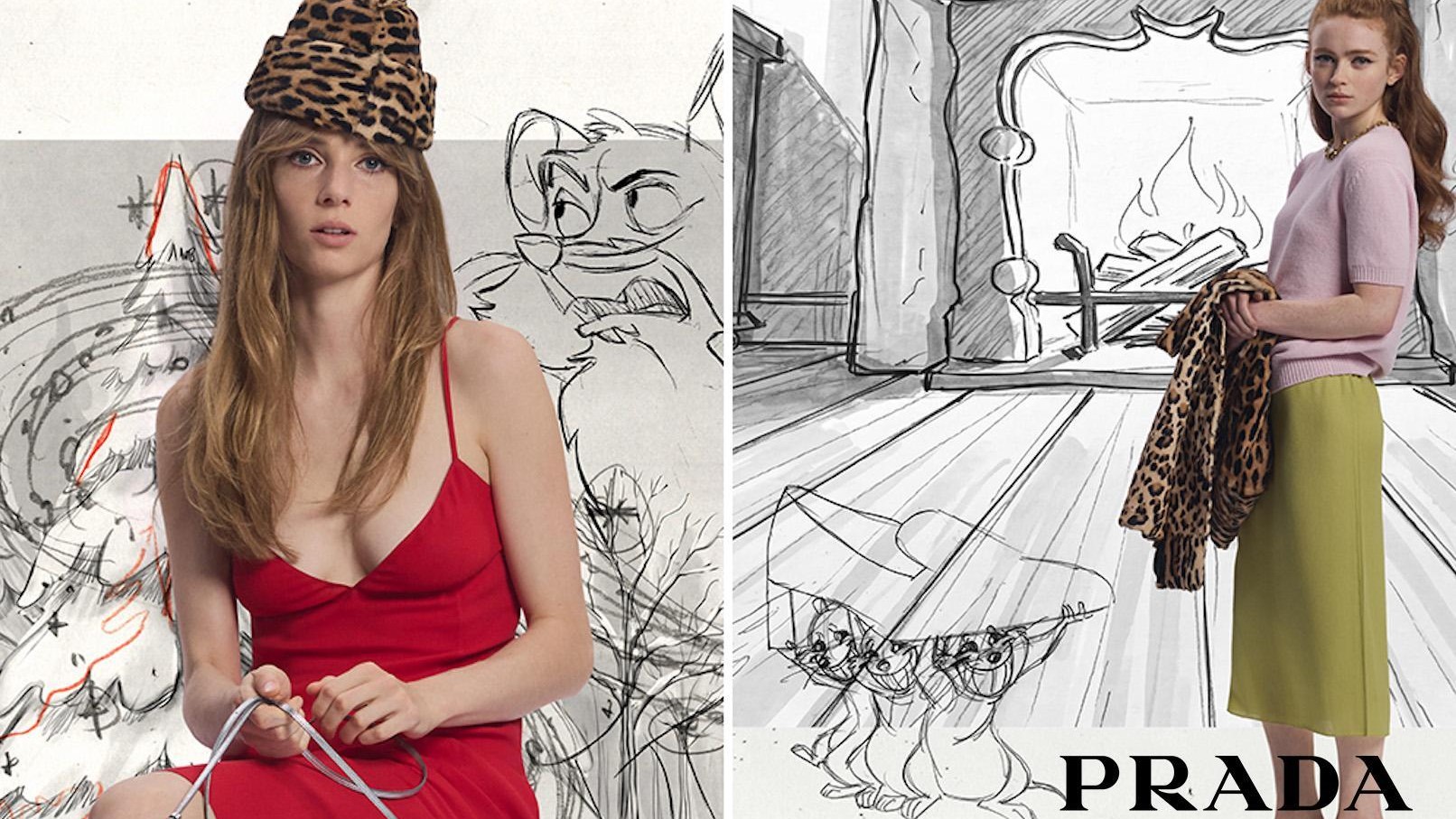
«Drawing Prada: Animated by Hand», de Prada, es el ejemplo más claro. La campaña presenta a una nueva generación de jóvenes intérpretes, como Sadie Sink y Maya Hawke, en un paisaje invernal de cuento en el que unas criaturas mágicas suspiran por las prendas de invierno de Prada. Con ilustradores que dibujan a mano, dirigidos por John Pomeroy, y con fotografía y película de imagen real de Glen Luchford, Prada presenta su campaña como una celebración del oficio, el tacto y la humanidad.
Levi’s, en cambio, eligió otro camino. Creó una película artesanal de claymation en stop-motion titulada «Let’s Get Fuzzy». Dirigida por Stevie Gee y Essy May, cuenta la historia de un grupo que pasa las fiestas en una cabaña en el bosque cuando, de repente, un yeti gigante y peludo irrumpe en su fiesta en la cabaña nevada y se contagia del espíritu navideño después de probarse las prendas de punto de Levi’s. La película es un homenaje a «Clayman», el primer anuncio de claymation de Levi’s, de 1995. Cada prenda en miniatura es una réplica exacta de la original y cada segundo de animación llevó cuatro horas de trabajo, lo que suma más de 2.000 horas de producción. Levi’s no es una casa de lujo, y precisamente por eso importa: cuando una marca vaquera puede construir una campaña sobre la artesanía a la vista, las casas de lujo ya no pueden apoyarse solo en la señal y tienen que seguir invirtiendo en artesanía para seguir siendo distintas.
Y no son las únicas. Apple, Anthropologie, e.l.f. y Loewe también han estrenado anuncios de claymation, de stop-motion o dibujados a mano, con vídeos de cómo se hicieron, mientras que Hermès, Diptyque, Barbour y Byredo están entre las marcas que esta temporada recurren a la artesanía.
Por qué vende lo «hecho por humanos»
El esfuerzo, sin embargo, sigue siendo un bien preciado. Al fin y al cabo, el lujo vende exclusividad, artesanía y la historia que acompaña al objeto. Por eso, el esfuerzo que hay detrás de producir contenido se vuelve todavía más valioso.
De hecho, las encuestas a consumidores parecen respaldar este argumento. Según un estudio de Harris Poll en colaboración con 4As e Infillion, el 73 % de los consumidores consideraría menos creíble un anuncio si pensara que está hecho con IA, mientras que el 63 % sería menos propenso a comprar a la marca que se anuncia así. Sin embargo, esta encuesta no se centra en los consumidores de lujo, donde la situación podría ser aún peor: según una encuesta del Journal of Advertising Research, revelar el uso de IA genera más reacciones negativas en los productos de lujo porque, como dice el estudio, esos anuncios requieren menos esfuerzo creativo.
Está también el problema de la confianza. Solo el 13 % de los consumidores cree que puede reconocer con mucha seguridad el contenido hecho con IA, según Cashew Research. Si la gente no puede identificar los anuncios por su aspecto, hacen falta pruebas. Ahí es donde entran en juego las imágenes de cómo se hizo.
Dior: cuando la promesa se convierte en el riesgo
Dior muestra lo frágil que puede ser esa prueba. Su película navideña, «Christian Dior’s Night in Color», se presentó como dibujada a mano y desató un debate en internet sobre si había intervenido la IA. Según el equipo de producción, el productor afirma que los artistas la dibujaron a lo largo de siete meses, con interpolación automática solo para los fotogramas intermedios, y WWD informó de que no había pruebas verificadas de forma independiente de IA generativa.
Lo que importa para el negocio es el mecanismo. Cuando un mensaje se centra en el trabajo puramente manual, esa afirmación se convierte en el centro del anuncio. La lección no va de una sola casa: en el lujo, cómo se hace algo forma parte de lo que compra el cliente, así que las marcas que prometen artesanía tienen que ser precisas sobre su proceso.
El nuevo lujo es la prueba
Esto no significa que el lujo no esté usando IA entre bastidores; ya lo hace. El cambio está en cómo deciden comunicar las marcas. El nuevo signo de estatus no es el nombre de una marca, sino la prueba, el tiempo, la destreza y el proceso.
Si las marcas vaqueras ya pueden hablar en términos de artesanía, las marcas de lujo no pueden limitarse a apropiarse de la expresión como eslogan. La diferenciación llega por la inversión en artesanía y por la honestidad al contarla, porque eso sostiene la credibilidad que legitima los precios altos. Así que la pregunta ya no es si la artesanía importa, sino quién puede demostrarla. Si «hecho a mano» se convierte en una frase de marketing más, ¿qué le quedará al lujo por vender?
En un mundo cada vez más moldeado por la inteligencia artificial, quizá parte del atractivo de la artesanía esté en la evidencia de la intervención humana. Hay algo intrínsecamente valioso en saber que un objeto ha sido hecho por manos humanas, con tiempo, destreza e incluso imperfecciones. A medida que la producción se automatiza cada vez más, el toque humano puede convertirse en un lujo en sí mismo. Quizá el próximo gran elemento diferenciador del lujo no sea solo la exclusividad, sino la humanidad.
We live in a world that has drastically changed. For better or worse, AI is all around us. Today, anyone can make a campaign, an editorial or a design in minutes. But when everyone can produce something polished, polish stops being special. This holiday season, Levi’s, Dior and Prada all released films using traditional techniques from stop-motion to hand-drawn animation, accompanied by a behind-the-scenes video of the creation. For these brands, it is not solely about nostalgia, it is a strategy: in a market where output is cheap and fast, the brands that continue to invest in craftsmanship are the ones who keep the power.
Three brands, one message
Prada’s “Drawing Prada: Animated by Hand” is the clearest example of this. The campaign introduces a new generation of young actors, such as Sadie Sink and Maya Hawke, in a winter wonderland where magical creatures long for Prada’s winter pieces. Brought to life by hand-drawn illustration artists led by John Pomeroy, combined with live-action photography and film by Glen Luchford, Prada presents its campaign as a celebration of craft, touch and humanity.
Levi’s, on the other hand, chose a different route. It created a handcrafted stop-motion claymation film called “Let’s Get Fuzzy”. Directed by Stevie Gee and Essy May, it tells the story of a group spending the holidays in a cabin in the forest when suddenly a giant, hairy yeti crashes their snowy cabin party and warms up to the holiday spirit after trying on Levi’s knitwear. The film is an homage to “Clayman”, Levi’s first claymation ad from 1995. Each miniature garment is an exact replica of the original and each second of animation took four hours to create, adding up to over 2,000 hours spent on production. Levi’s is not a luxury house, and that is exactly why it matters: when a denim brand can build a campaign on visible craft, luxury houses can no longer rely on the signal alone, and must keep investing in craftsmanship to stay different.
And these are not the only ones. Apple, Anthropologie, e.l.f. and Loewe have also debuted claymation, stop-motion or hand-drawn ads with behind-the-scenes videos, while Hermès, Diptyque, Barbour and Byredo are among the brands turning to craftsmanship this season.
Why “made by humans” sells
Effort, however, remains a precious commodity. After all, luxury sells on exclusivity, craftsmanship, and the story attached to the item. Thus, the effort behind producing content becomes even more valuable.
Indeed, consumer surveys seem to support this argument. According to a Harris Poll study in partnership with 4As and Infillion, 73% of consumers would find an ad less credible if they thought it was AI-made, while 63% of them would be less likely to shop from the brand advertising in such a way. However, this survey does not specifically address luxury consumers, where the situation might be worse yet: according to a Journal of Advertising Research survey, AI disclosure brings more negative feedback regarding luxury products because, as the study says, such ads require less creative effort.
There is also the problem of trust. Just 13% of consumers believe they can recognize AI-made content with high confidence, says Cashew Research. If people cannot identify the ads based on their looks, proof is necessary. This is where the behind-the-scenes footage comes into play.
Dior: when the claim becomes the risk
Dior shows how fragile that proof can be. Its holiday film, “Christian Dior’s Night in Color,” was presented as hand-drawn and sparked online debate about whether AI was involved. According to the production team, the producer says artists drew it over seven months, with automated interpolation used only for in-between frames, and WWD reported no independently verified evidence of generative AI.
What matters for business is the mechanism. When a message centres on pure manual work, that claim becomes the focus of the ad. The lesson is not about one house: in luxury, how something is made is part of what the customer buys, so brands that promise craft must be precise about their process.
The new luxury is proof
It doesn’t mean luxury isn’t using AI behind the scenes, it already is. The shift lies in how brands decide to communicate. The new signifier of status isn’t a brand name, but proof, time, skill and process.
If denim brands can now use terms of craft, then luxury brands can’t simply co-opt the phrase as a tagline. The differentiation comes through investment in craft and honesty about it, since that supports the credibility that legitimizes premium pricing. So the question is no longer whether craft matters, but who can prove it. If “handmade” becomes just another marketing line, what will luxury have left to sell?
In a world increasingly shaped by artificial intelligence, perhaps part of the appeal of craftsmanship lies in the evidence of human intervention. There is something inherently valuable about knowing that an object has been made by human hands, with time, skill and even imperfections. As production becomes increasingly automated, the human touch may become a luxury in itself. Perhaps luxury’s next major differentiator will not just be exclusivity, but humanity.
Fuentes
- Prada, 2026. «Drawing Prada: Animated by Hand»
- Prada, 2026. «The Making of Drawing Prada: Animated by Hand»
- Christian Dior, 2026. «Christian Dior’s Night in Color»
- Levi’s, 2026. «A Frighteningly Fuzzy Holiday»
- Levi’s, 2026. «The Making of Let’s Get Fuzzy»
- Levi’s, 1995. «Levi’s 501 commercial (Clayman)»
- Prada, 2026. «Holiday»
- Vogue Adria, 2026
- Levi Strauss & Co., 2026. «Let’s Get Fuzzy: Meet the Levi’s® Holiday Campaign»
- Levi Strauss & Co., 2025. «When Clay Met Levi’s®: The Levi’s® Brand’s First Global Ad»
- Marketing Brew, 2026. «Consumers are sick and tired of hearing about AI all the time»
- 4As, 2026. «Consumers Are Sick and Tired of Hearing About AI All the Time»
Compártelo en tu historia
- Descarga la imagen.
- Súbela a tu historia de Instagram.
- Añade el sticker de enlace y pega el del artículo: ya lo tienes copiado.