
El activo que todos quieren, el hogar que pocos pueden pagar
La vivienda se ha consolidado como uno de los activos más atractivos del mercado inmobiliario español. Sin embargo, mientras su valor aumenta, acceder a ella se convierte en un desafío para miles de hogares. ¿Puede un mercado ser cada vez más rentable y, al mismo tiempo, menos accesible?
Comprar una vivienda ha sido tradicionalmente una de las principales formas de construir patrimonio. Sin embargo, en España esta aspiración parece alejarse cada vez más de una parte importante de la población. Los precios continúan creciendo, el interés inversor por el sector residencial se mantiene elevado y, para muchos jóvenes, independizarse se ha convertido en una decisión condicionada por su capacidad económica.
Según el Instituto Nacional de Estadística (INE), el precio de la vivienda aumentó un 12,2% interanual en el segundo trimestre de 2026. La vivienda de segunda mano registró incluso un incremento del 12,9%. Detrás de estas cifras se encuentra una paradoja: el mismo activo que gana atractivo para los inversores se vuelve más difícil de alcanzar para quienes necesitan un hogar.
Dos formas de entender el mismo activo
Desde una perspectiva financiera, una vivienda representa una oportunidad de inversión. Puede generar ingresos mediante el alquiler, revalorizarse con el tiempo y formar parte de una estrategia de diversificación patrimonial. Este atractivo ha impulsado el interés de fondos, promotoras y otros inversores institucionales por el sector residencial.
Los datos de CBRE reflejan esta tendencia: durante el primer semestre de 2026, el segmento Living —que incluye vivienda en alquiler, residencias de estudiantes y otros formatos residenciales— superó los 4.500 millones de euros de inversión en España, representando el 38% del volumen total invertido en el mercado inmobiliario.
Pero la lógica del inversor no es necesariamente la misma que la del comprador. Mientras el primero analiza rentabilidad, ocupación y revalorización, el segundo busca estabilidad, independencia y un lugar donde vivir. Ambos participan en el mismo mercado, pero persiguen objetivos diferentes.
El problema aparece cuando el precio que resulta atractivo para quien busca rentabilidad supera la capacidad económica de quienes necesitan acceder a una vivienda.
Cuando la oferta no sigue el ritmo de la demanda
Sin embargo, atribuir la crisis de acceso únicamente a la inversión sería simplificar demasiado el problema. Una de las principales causas se encuentra en el desequilibrio entre la oferta y la demanda. El Banco de España estima que durante 2025 se crearon alrededor de 240.000 hogares netos, mientras que se terminaron unas 92.000 viviendas nuevas. Esa brecha, repetida año tras año, ha acumulado un déficit de unas 750.000 viviendas entre 2021 y 2025.
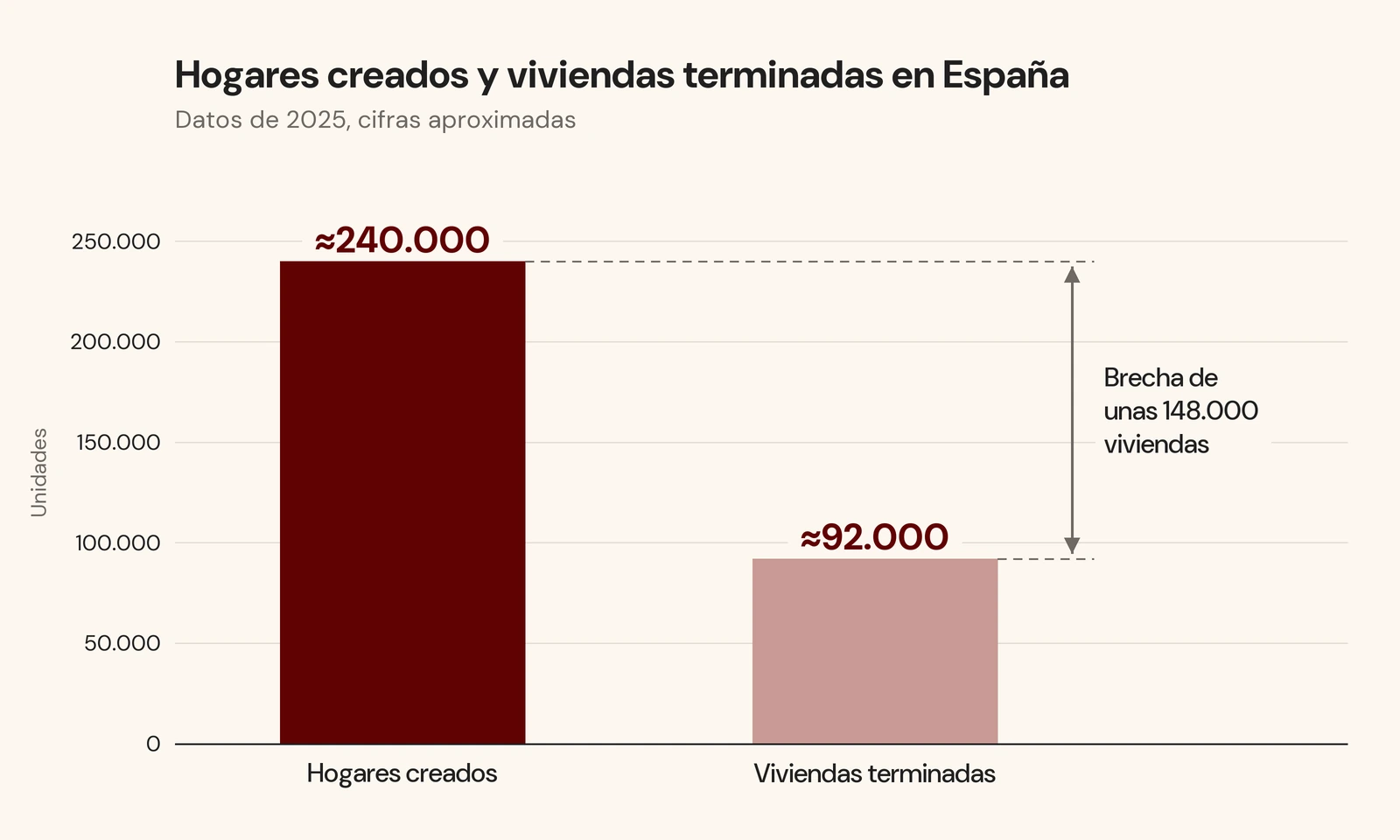
La escasez de oferta, las dificultades para desarrollar suelo, los costes de construcción y el crecimiento de la población contribuyen a mantener la presión sobre los precios. En este contexto, la entrada de capital puede aumentar la competencia por determinados activos, aunque no constituye por sí sola la explicación del encarecimiento.
La cuestión no es, por tanto, si la inversión inmobiliaria es positiva o negativa, sino qué ocurre cuando el capital encuentra oportunidades en un mercado donde la oferta residencial no consigue responder a las necesidades de la población.
El coste de quedarse fuera del mercado
Las consecuencias van más allá de las estadísticas inmobiliarias. Según el INE, el 44,3% de las personas de entre 26 y 34 años vivía con sus padres en 2025. Entre quienes se encontraban en esta situación, el 47,3% señalaba que no podía permitirse comprar o alquilar una vivienda.
Esta dificultad retrasa decisiones personales y familiares, limita la movilidad laboral y condiciona la capacidad de ahorro de las nuevas generaciones. Además, crea una diferencia patrimonial entre quienes ya poseen una vivienda y pueden beneficiarse de su revalorización y quienes todavía intentan acceder al mercado.
Para los primeros, el aumento de los precios puede representar un incremento de su patrimonio. Para los segundos, supone una barrera de entrada cada vez mayor. Así, la vivienda puede convertirse en un factor que amplía las diferencias entre quienes ya disponen de activos inmobiliarios y quienes dependen exclusivamente de sus ingresos.
La inversión inmobiliaria no tiene por qué estar enfrentada al derecho a la vivienda. De hecho, puede contribuir a financiar nuevas construcciones y aumentar la oferta de alquiler. Pero para que ambas funciones sean compatibles, el mercado necesita algo más que capital: necesita viviendas suficientes y accesibles.
La paradoja de la vivienda no está en que tenga valor económico, sino en que su valor como inversión pueda crecer mientras pierde accesibilidad como hogar. Porque una vivienda puede ser una excelente oportunidad para quien busca rentabilidad, pero su verdadero valor económico y social también debería medirse por algo mucho más sencillo: cuántas personas pueden permitirse vivir en ella.
Buying a home has traditionally been one of the main ways of building wealth. In Spain, however, that aspiration seems to be slipping further and further out of reach for a significant part of the population. Prices continue to rise, investor interest in the residential sector remains high and, for many young people, moving out has become a decision constrained by their financial means.
According to Spain’s National Statistics Institute (INE), house prices rose 12.2% year on year in the second quarter of 2026. Prices of second-hand homes rose even more, by 12.9%. Behind these figures lies a paradox: the same asset that is becoming more attractive to investors is becoming harder to reach for those who need a home.
Two ways of looking at the same asset
From a financial perspective, a home is an investment opportunity. It can generate income through rent, appreciate over time and form part of a wealth diversification strategy. This appeal has driven the interest of funds, developers and other institutional investors in the residential sector.
CBRE data reflect this trend: in the first half of 2026, the Living segment, which includes rental housing, student residences and other residential formats, exceeded €4.5 billion of investment in Spain, accounting for 38% of the total volume invested in the real estate market.
But the investor’s logic is not necessarily the same as the buyer’s. While the former analyses yield, occupancy and appreciation, the latter is looking for stability, independence and a place to live. Both take part in the same market, but they pursue different goals.
The problem arises when the price that is attractive to those seeking a return exceeds the financial capacity of those who need to get a home.
When supply does not keep pace with demand
Even so, attributing the access crisis solely to investment would be to oversimplify the problem. One of the main causes lies in the imbalance between supply and demand. The Bank of Spain estimates that in 2025 around 240,000 net new households were formed, while some 92,000 new homes were completed. That gap, repeated year after year, has built up a deficit of around 750,000 homes between 2021 and 2025.
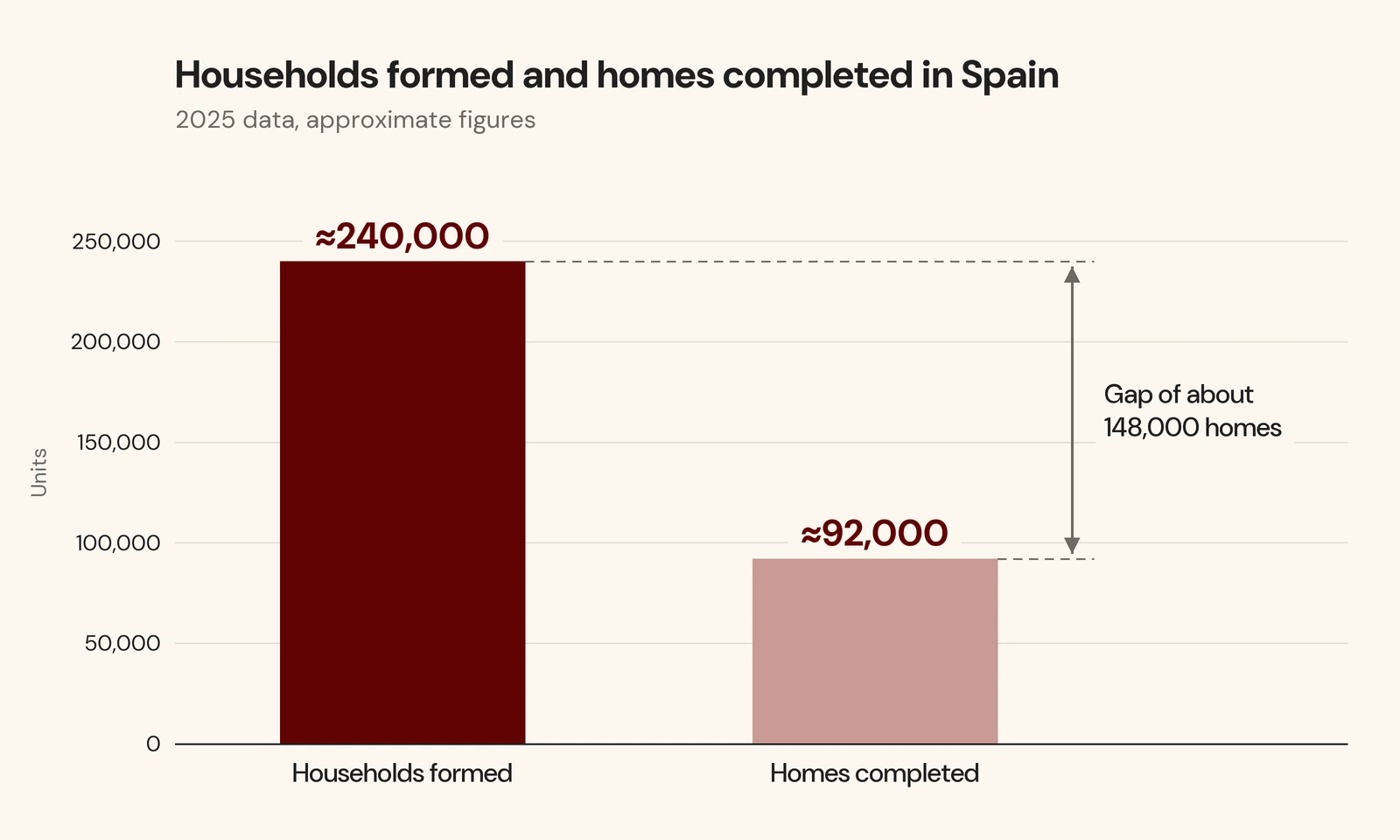
The shortage of supply, the difficulties of developing land, construction costs and population growth all help keep pressure on prices. In this context, the entry of capital can increase competition for certain assets, although it does not by itself explain the rise in prices.
The question, therefore, is not whether real estate investment is good or bad, but what happens when capital finds opportunities in a market where residential supply fails to respond to the needs of the population.
The cost of being shut out of the market
The consequences go beyond real estate statistics. According to INE, 44.3% of people aged 26 to 34 were living with their parents in 2025. Among those in that situation, 47.3% said they could not afford to buy or rent a home.
This difficulty delays personal and family decisions, limits labour mobility and constrains the ability of younger generations to save. It also creates a wealth gap between those who already own a home and can benefit from its appreciation and those who are still trying to get onto the market.
For the former, rising prices can mean an increase in their wealth. For the latter, they mean an ever higher barrier to entry. Housing can thus become a factor that widens the gap between those who already hold real estate assets and those who depend solely on their income.
Real estate investment does not have to be at odds with the right to housing. In fact, it can help finance new construction and increase the supply of rental homes. But for both functions to be compatible, the market needs more than capital: it needs enough homes, and homes that are affordable.
The paradox of housing is not that it has economic value, but that its value as an investment can grow while it becomes less accessible as a home. A home can be an excellent opportunity for those seeking a return, but its true economic and social value should also be measured by something much simpler: how many people can afford to live in it.
Compártelo en tu historia
- Descarga la imagen.
- Súbela a tu historia de Instagram.
- Añade el sticker de enlace y pega el del artículo: ya lo tienes copiado.