
¿Quién fija realmente el precio del alquiler en España?
Un reciente estudio de EsadeEcPol revela que los propietarios con varias viviendas cobran alquileres superiores. Pero ¿se debe a su poder de mercado o a una gestión más profesionalizada?
Imaginemos dos pisos prácticamente iguales, situados en el mismo barrio. Uno pertenece a alguien que solo alquila esa vivienda; el otro, a un propietario con veinte inmuebles. ¿Deberían pagar lo mismo sus inquilinos?
Según un estudio de EsadeEcPol, en 2023 los propietarios con varias viviendas cobraban, de media, un 3,5% más por inmuebles comparables. La diferencia plantea una cuestión económica interesante: ¿pueden los grandes propietarios influir en el mercado o simplemente gestionan sus alquileres de manera diferente?
¿Cuánto más cobran los grandes propietarios?
En octubre de 2026, EsadeEcPol publicó Concentración de la propiedad y precios de alquiler en España, un estudio basado en 788.033 observaciones de viviendas entre 2019 y 2023.
El informe compara los alquileres cobrados por propietarios con una sola vivienda y por aquellos con varias, denominados multiarrendadores. Para evitar comparaciones engañosas, tiene en cuenta características como la superficie y la localización de los inmuebles.
Los resultados son reveladores. En 2019, la diferencia entre ambos grupos era prácticamente inexistente: apenas un 0,8%, sin significación estadística. Cuatro años después, había aumentado hasta el 3,5%.
Además, cuanto mayor era la cartera, mayor tendía a ser la diferencia. Durante el período analizado, los propietarios con dos viviendas cobraban aproximadamente un 1,3% más que aquellos con una sola, mientras que la prima alcanzaba el 4,5% entre quienes tenían cinco o más.
También se observan diferencias al renovar los contratos: los multiarrendadores incrementaban las rentas un 5,2% de media, frente al 3,8% de los propietarios con una sola vivienda.
Pero que unos propietarios cobren más no significa necesariamente que tengan capacidad para encarecer el conjunto del mercado. Para entender esa diferencia, podemos recurrir a la teoría económica.
¿Qué nos enseña Cournot sobre el alquiler?
Imaginemos un barrio con cien viviendas disponibles para alquilar. Si un propietario controla cincuenta, podría tener cierta capacidad para influir en la oferta y, con ello, en los precios. En cambio, alguien que posee un único piso difícilmente puede alterar por sí solo el alquiler del resto del barrio.
Esta intuición está relacionada con el modelo de oligopolio de Cournot, que estudia cómo compiten las empresas cuando deciden qué cantidad ofrecer al mercado.
Bajo los supuestos de este modelo, el índice de Lerner relaciona el margen de una empresa con su cuota de mercado y la sensibilidad de la demanda al precio:
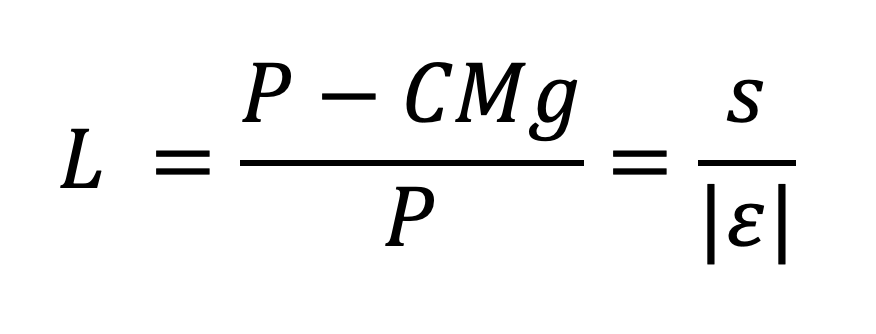
Donde P representa el precio, CMg el coste marginal, s la cuota de mercado y ε la elasticidad de la demanda.
La idea es sencilla: cuanto mayor sea la cuota de mercado y menos sensible sea la demanda al precio, mayor podrá ser el margen.
Trasladado al alquiler, esto implica que no es lo mismo poseer cien pisos repartidos por España que controlar una parte importante de las viviendas disponibles en un barrio. Lo relevante es la cuota dentro del mercado donde realmente compiten los propietarios.
Cournot es una simplificación del mercado inmobiliario, pero nos permite plantear una hipótesis interesante: si los multiarrendadores cobran más gracias a su poder de mercado, cabría esperar primas superiores cuando sus viviendas están concentradas geográficamente.
¿Es eso lo que encontramos?
EsadeEcPol analiza precisamente cómo cambia la prima de alquiler según la distribución geográfica de las viviendas de cada propietario.
Los resultados son contraintuitivos: la prima estimada es del 2,8% cuando las viviendas están repartidas entre varios municipios, cae al 1,5% cuando están en uno solo y llega a ser negativa (−3,8%) cuando todas se concentran en la misma sección censal.
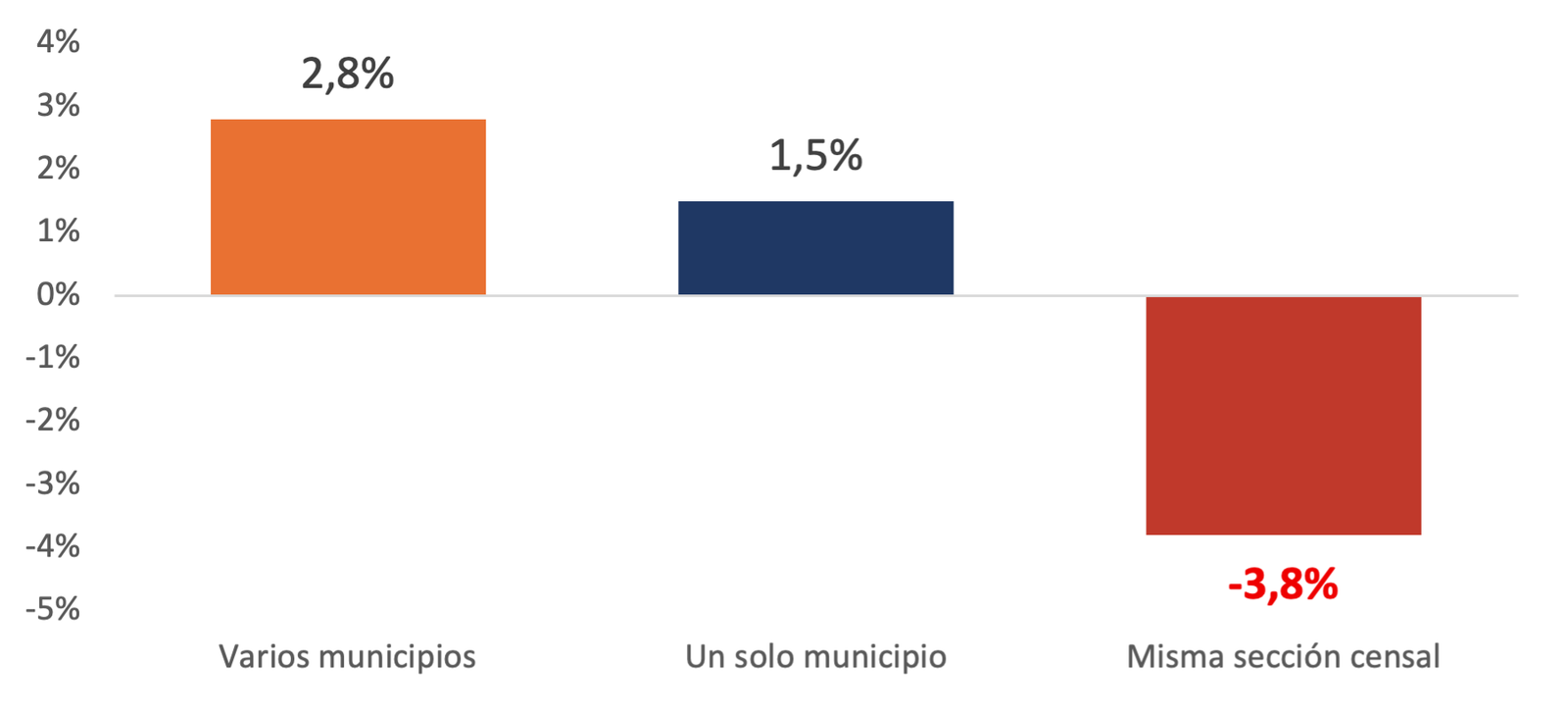
Es decir, los propietarios que tienen sus viviendas más próximas entre sí no presentan las primas más elevadas.
¿Cómo podemos explicarlo?
Una posibilidad es la profesionalización. Quien gestiona una cartera de inmuebles puede disponer de mejor información sobre los precios, mayor experiencia negociando contratos y más incentivos para actualizar las rentas. Eso podría permitirle cobrar más sin necesidad de dominar un mercado local.
Pero hay una distinción importante: concentrar todas tus viviendas en un barrio no significa controlar una gran parte de ese barrio. Un propietario puede tener cinco pisos juntos y representar menos del 1% de la oferta local.
Por tanto, el estudio no demuestra que el poder de mercado sea irrelevante. Simplemente encuentra que, entre los particulares analizados, la mayor concentración geográfica de sus carteras no está asociada a primas superiores.
Y existe otra limitación: al utilizar declaraciones del IRPF, el estudio analiza propietarios particulares, no fondos de inversión ni sociedades inmobiliarias.
¿Provocar una subida o anticiparla?
Incluso cuando observamos alquileres superiores, debemos distinguir entre correlación y causalidad. Un inversor puede comprar viviendas en un barrio porque prevé que aumentará la demanda. Si después suben los alquileres, ¿ha provocado ese encarecimiento o simplemente ha anticipado una tendencia?
Para conocer el efecto real del inversor necesitaríamos estimar qué habría ocurrido sin su entrada. Por eso, observar una prima de alquiler no basta para demostrar que un propietario ha encarecido el mercado.
El factor que no podemos ignorar
La estructura de propiedad puede influir en cómo se fijan los alquileres, pero hay otro factor fundamental: la relación entre oferta y demanda.
Según el Informe Anual 2025 del Banco de España, en 2025 se crearon aproximadamente 240.000 hogares, mientras que se terminaron 92.000 viviendas. Entre 2021 y 2025, el diferencial acumulado entre formación de hogares y construcción residencial ronda las 750.000 viviendas.
Aunque esa cifra no representa exactamente el número de pisos que faltan, evidencia una importante presión estructural sobre la oferta.
Los resultados de EsadeEcPol muestran que el tamaño del propietario está relacionado con diferencias en los alquileres, pero no permiten atribuirlas directamente a su poder de mercado.
La conclusión es que cobrar más por una vivienda no equivale necesariamente a provocar una subida en todo el mercado. Para entender los precios debemos distinguir entre la capacidad de fijar rentas de cada propietario y las condiciones de oferta y demanda que afectan al conjunto del mercado.
A recent EsadeEcPol study reveals that landlords with multiple properties charge higher rents. But is this due to their market power or more professional management?
Imagine two virtually identical apartments located in the same neighborhood. One belongs to someone who rents only that property; the other belongs to an owner with twenty properties. Should their tenants pay the same?
According to an EsadeEcPol study, in 2023 landlords with multiple properties charged, on average, 3.5% more for comparable properties. The difference raises an interesting economic question: can large landlords influence the market or do they simply manage their rentals differently?
How much more do large landlords charge?
In October 2026, EsadeEcPol published Concentration of Ownership and Rental Prices in Spain, a study based on 788,033 observations of properties between 2019 and 2023.
The report compares rents charged by owners with a single property and those with multiple properties, referred to as multi-landlords. To avoid misleading comparisons, it accounts for characteristics such as property size and location.
The results are revealing. In 2019, the difference between the two groups was practically nonexistent: barely 0.8%, without statistical significance. Four years later, it had increased to 3.5%.
Furthermore, the larger the portfolio, the greater the difference tended to be. During the period analyzed, owners with two properties charged approximately 1.3% more than those with just one, while the premium reached 4.5% among those with five or more.
Differences are also observed when renewing contracts: multi-landlords increased rents by 5.2% on average, compared to 3.8% for single-property owners.
But the fact that some landlords charge more does not necessarily mean they have the capacity to raise prices across the entire market. To understand that difference, we can turn to economic theory.
What does Cournot teach us about rentals?
Imagine a neighborhood with one hundred properties available for rent. If one owner controls fifty, they might have some capacity to influence supply and, with it, prices. In contrast, someone who owns a single apartment can hardly alter the rental market in the rest of the neighborhood on their own.
This intuition is related to Cournot's oligopoly model, which studies how firms compete when deciding what quantity to supply to the market.
Under the assumptions of this model, the Lerner index relates a firm's margin to its market share and the sensitivity of demand to price:
Where P represents price, CMg marginal cost, s market share, and ε demand elasticity.
The idea is straightforward: the larger the market share and the less sensitive demand is to price, the greater the margin can be.
Applied to rentals, this implies that owning one hundred apartments spread across Spain is not the same as controlling a significant portion of available properties in a neighborhood. What matters is the market share within the market where landlords actually compete.
Cournot is a simplification of the real estate market, but it allows us to propose an interesting hypothesis: if multi-landlords charge more thanks to their market power, we would expect higher premiums when their properties are geographically concentrated.
Is that what we find?
EsadeEcPol precisely analyzes how the rental premium changes according to the geographic distribution of each landlord's properties.
The results are counterintuitive: the estimated premium is 2.8% when properties are spread across multiple municipalities, falls to 1.5% when they are in just one, and becomes negative (−3.8%) when all are concentrated in the same census section.
That is, landlords whose properties are closest to each other do not present the highest premiums.
How can we explain this?
One possibility is professionalization. Someone managing a portfolio of properties can have better information about prices, greater experience negotiating contracts, and more incentives to update rents. This could allow them to charge more without needing to dominate a local market.
But there is an important distinction: concentrating all your properties in one neighborhood does not mean controlling a large share of that neighborhood. A landlord can own five apartments together and represent less than 1% of local supply.
Therefore, the study does not demonstrate that market power is irrelevant. It simply finds that, among the individuals analyzed, greater geographic concentration of their portfolios is not associated with higher premiums.
And there is another limitation: by using income tax returns, the study analyzes individual property owners, not investment funds or real estate companies.
Causing a rise or anticipating it?
Even when we observe higher rents, we must distinguish between correlation and causality. An investor may buy properties in a neighborhood because they foresee increased demand. If rents rise afterward, has that investor caused the increase or simply anticipated a trend?
To understand the actual effect of the investor, we would need to estimate what would have happened without their entry. That is why observing a rental premium is not sufficient to prove that a landlord has raised market prices.
The factor we cannot ignore
Property ownership structure can influence how rents are set, but there is another fundamental factor: the relationship between supply and demand.
According to the Bank of Spain's Annual Report 2025, in 2025 approximately 240,000 households were formed, while 92,000 homes were completed. Between 2021 and 2025, the cumulative differential between household formation and residential construction is around 750,000 properties.
Although this figure does not represent exactly the number of apartments that are missing, it evidences significant structural pressure on supply.
EsadeEcPol's results show that landlord size is related to differences in rents, but do not allow us to attribute them directly to their market power.
The conclusion is that charging more for a property does not necessarily equate to causing a rise across the entire market. To understand prices, we must distinguish between each landlord's ability to set rents and the supply and demand conditions that affect the market as a whole.
Compártelo en tu historia
- Descarga la imagen.
- Súbela a tu historia de Instagram.
- Añade el sticker de enlace y pega el del artículo: ya lo tienes copiado.