El problema del milenio
Un remolino infinitamente rápido en tu café
Imagina que estás tomándote tu café de por las mañanas, lo acabas de sacar de la cafetera, le echas leche, el líquido está ahora quieto en su taza. Para juntar bien la leche y el café, comienzas a removerlo con una cucharilla, no das golpes ni haces movimientos infinitamente bruscos o, como diría un matemático, aplicas una fuerza “suave”.
Por algún motivo, enciendes un cronómetro, quieres observar tu café durante exactamente 10 segundos, no paras de remover. Al principio, nada extraño ocurre, pero a medida que te acercas al segundo 10, se empieza a formar un remolino, concentrado en una zona específica del café.
En el segundo 9, el remolino todavía gira a una velocidad concreta, sin sorpresas. A los 9,9 segundos, el remolino está ahora concentrado en una zona mucho más pequeña del café y gira muchísimo más deprisa que antes. Nueve centésimas de segundo después, el espacio que ocupa el remolino vuelve a reducirse y su velocidad aumenta todavía más. Nueve milésimas de segundo después, el remolino es ahora aún más pequeño y rápido. Este proceso continúa, el remolino se hace cada vez más pequeño y más rápido.
El proceso es tan brutal que si piensas en un número, el más grande que conozcas, hay garantía de que antes del segundo 10, algún punto del remolino habrá alcanzado esa velocidad. Y, sin embargo, la energía total del fluido nunca se dispara. Al igual que una cerilla encendida, aunque su llama está extremadamente caliente, no consigue calentar una habitación entera porque la cerilla contiene poca energía total.
Con el remolino sucede algo parecido. Aunque alcanza velocidades cada vez mayores, ese movimiento extremo queda encerrado en una porción de café cada vez más pequeña. La velocidad se dispara, pero la energía del conjunto permanece limitada.
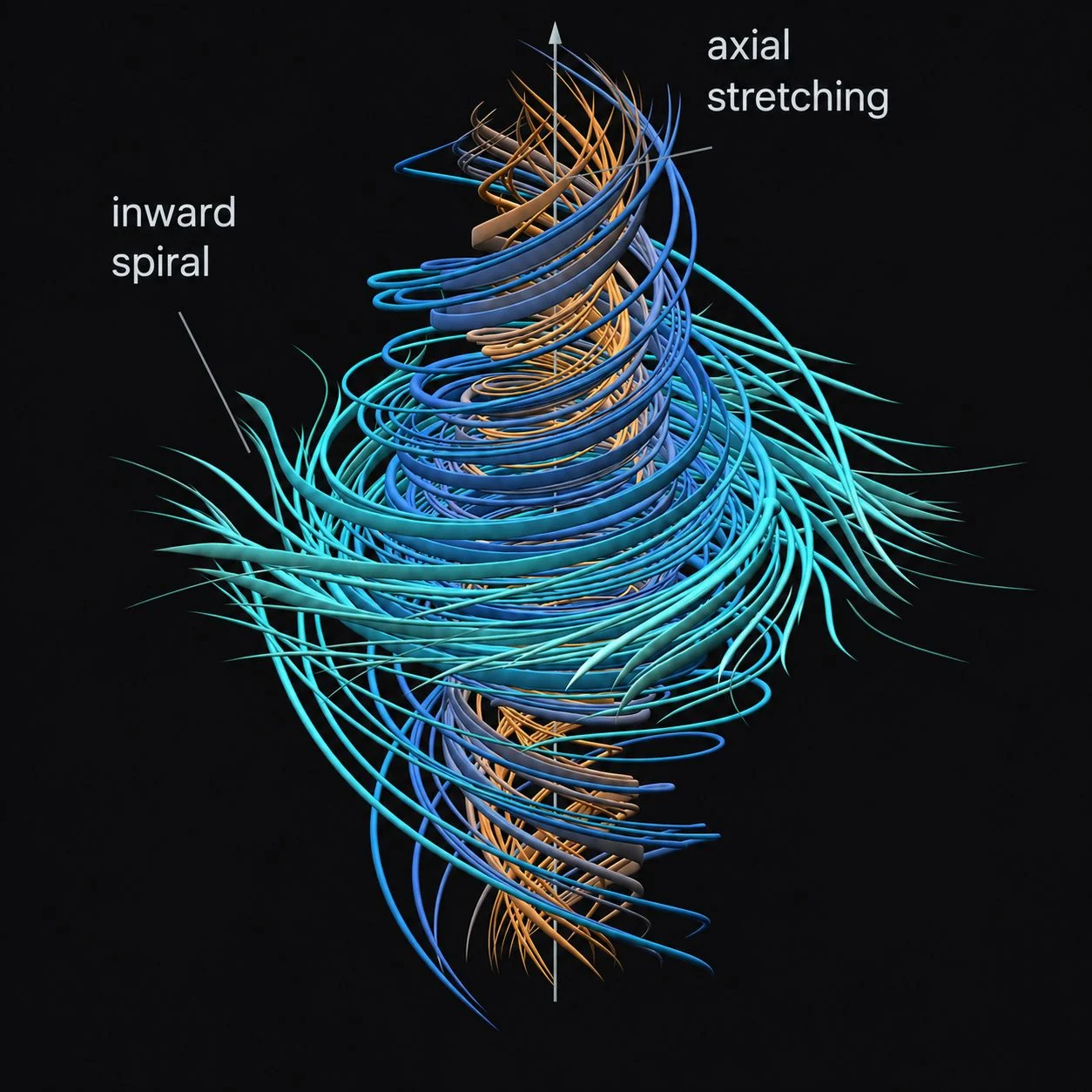
Representación gráfica del “remolino” de la solución de OpenAI.
Afortunadamente, esto no ocurre en la vida real, solo en un modelo matemático: las ecuaciones de Navier-Stokes. Pero esto es precisamente lo que OpenAI afirma haber demostrado, gracias a aproximadamente 10.000 agentes de inteligencia artificial que obtuvieron la solución 88 horas después de poner a trabajar a los primeros agentes y con una fuerza bastante más compleja que remover con una cucharilla, pero también suave, que es lo que pedía la variante del problema que OpenAI atacó. El resultado, de 166 páginas, pretende resolver una de las cuatro variantes oficiales del problema del milenio, la variante con fuerza suave, demostrando no que el fluido siempre se comporta bien, sino que puede llegar a “romperse”.
¿Pero qué es un problema del milenio?
En el año 2000, el Instituto Clay seleccionó siete de las grandes preguntas que llevaban años o incluso generaciones sin resolverse y prometió un premio de un millón de dólares a cualquiera que lograse resolver alguna de las preguntas. A día de hoy, solo una de las siete figura como oficialmente resuelta, la conjetura de Poincaré, resuelta en 2003 por Grigori Perelman, un matemático ruso que rechazó el premio.
Hasta ahora, incluso con el incentivo del millón de dólares, ningún otro problema había sido resuelto y no por falta de intentos. Solo en arXiv, uno de los principales repositorios de investigación científica, aparecen más de 4.300 trabajos con “Navier-Stokes” en el título. No todos intentan resolver directamente el problema del milenio, muchos estudian casos parciales o ecuaciones relacionadas. Pero la cifra permite hacerse una idea de la cantidad de mentes brillantes que han trabajado alrededor de esta pregunta cuya forma moderna se remonta a los trabajos de Jean Leray en 1934.
¿Y cómo lo consiguieron?
Esto es lo que dice OpenAI, cronológicamente.
El 28 de agosto OpenAI comienza el entrenamiento de un nuevo modelo interno, hasta ahora desconocido, que es bastante superior a Astra en matemáticas.
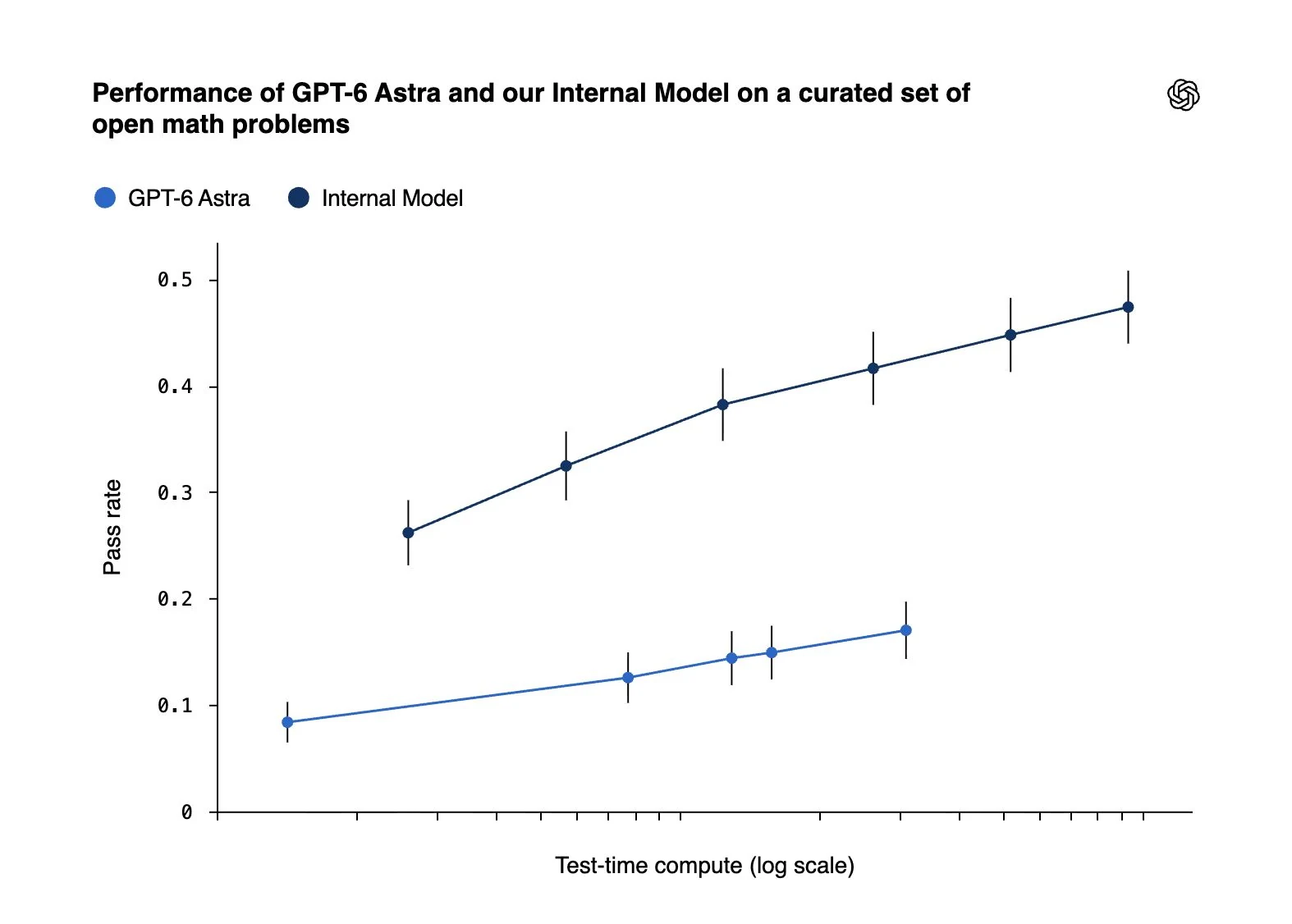
Fuente: OpenAI.
El 1 de septiembre, OpenAI escucha rumores de que se han resuelto dos problemas del milenio usando IA. Impulsados por estos rumores, OpenAI decide lanzar un experimento, intentar resolver todos los problemas del milenio abiertos, usando su nuevo modelo interno. Pero no los lanzan a lo loco, los lanzan de la siguiente manera: crean varios grupos de agentes, cada uno con estrategias distintas. Los agentes pueden ejecutar código, consultar una versión en caché de internet y comunicarse con los otros agentes de su grupo. Además de los problemas del milenio, OpenAI introduce problemas más sencillos o que sirven como paso intermedio para las resoluciones de los problemas del milenio.
Uno de estos problemas intermedios es el problema de regularidad de Euler, que son unas ecuaciones similares a las de Navier-Stokes pero simplificadas, sin viscosidad. Más tarde, OpenAI descubriría que estas eran las ecuaciones que habían sido resueltas por inteligencia artificial (en una de sus variantes) y las que habían desatado los rumores originales.
Primer avance: Un grupo de casi cien agentes trabaja durante aproximadamente cincuenta horas y produce, según OpenAI, una demostración de que las ecuaciones de Euler pueden desarrollar una singularidad sin necesidad de aplicar una fuerza externa. Este resultado, “Euler sin fuerza”, que nadie había conseguido probar hasta ahora y que por sí solo habría sido algo reseñable, convence a la compañía de que Navier-Stokes es el objetivo más prometedor. Euler (al igual que Navier-Stokes) tiene dos variantes, una con fuerza y una sin fuerza, la de sin fuerza es más fuerte, es decir, más compleja y mucho más relevante.
OpenAI retira agentes de los demás problemas, los concentra en Navier-Stokes (ambas variantes) y les proporciona la solución de Euler sin fuerza como punto de partida.
El entrenamiento del modelo interno encargado de este experimento continúa. Cada vez que OpenAI obtiene una nueva versión del modelo, todos los agentes que trabajan en Navier-Stokes la reciben.
OpenAI sigue atacando Navier-Stokes con estrategia, cada grupo de agentes explora maneras diferentes de conseguir la solución, posteriormente, OpenAI recopila las ideas más prometedoras de los grupos y las convierte en nuevas instrucciones. Estas instrucciones que vienen de las ideas más prometedoras de todos los grupos son las que finalmente provocan que un grupo de agentes encuentre la solución.
El grupo que finalmente consigue la solución llega a trabajar con aproximadamente 10.000 agentes al mismo tiempo. El sábado 5 de septiembre, unas 88 horas después de poner en marcha los primeros agentes y tras 2,7 millones de mensajes intercambiados entre agentes, este grupo lo consigue.
A continuación, el modelo público GPT-6 Astra dedica 17 horas a convertirla en una demostración formal escrita en Lean (Lean es un software que comprueba que los pasos lógicos de la demostración no tengan huecos) y a comprobarla dentro de ese sistema. El 6 de septiembre, la solución está encontrada y formalizada en Lean, sin mensajes de error.
El 6 de septiembre, OpenAI contacta con Buckmaster y Alpöge. Hasta este momento, OpenAI pensaba que ellos también habían conseguido resolver el problema de Navier-Stokes. Es ahora cuando OpenAI descubre que Buckmaster y Alpöge solo habían resuelto Euler con fuerza, es decir, la variante débil de Euler.
La madrugada del 8 de septiembre, Buckmaster y Alpöge hacen públicos sus resultados, que incluyen, entre otros, Euler con fuerza. Ellos nunca afirman que tengan Navier-Stokes, pero sí dicen que están trabajando en una versión simplificada de Navier-Stokes.
El 8 de septiembre, OpenAI publica su resultado de Navier-Stokes con fuerza, junto con su verificación con Lean. Esto no equivale a una confirmación de que es correcta, por normativa de los problemas del milenio, deben pasar mínimo 2 años desde su publicación hasta que pueda ser oficialmente reconocida como solución, además de que el Instituto Clay haga su propia verificación y confirme que es válida. Oficialmente el problema de Navier-Stokes todavía no ha sido resuelto.
La importancia de dos matemáticos españoles en toda esta historia
Un detalle, de mucha importancia: una de las ideas sobre las que se apoya la prueba de OpenAI nació en España. Diego Córdoba, del CSIC, y Luis Martínez-Zoroa, de CUNEF, llevaban casi una década desarrollando la “cascada de capas de vorticidad”, una estrategia para crear una singularidad mediante capas cada vez más pequeñas, donde cada una amplifica la siguiente. OpenAI cita expresamente sus trabajos y reconoce que establecieron esta estrategia, aunque su demostración utiliza esas amplificaciones de una forma distinta.
Por tanto, una de las ideas técnicas centrales es española. Córdoba y Martínez-Zoroa ya la habían utilizado para producir singularidades en Euler con fuerza. Además, junto a Fan Zheng, la aplicaron a una versión de Navier-Stokes con una viscosidad más débil. OpenAI afirma haber conseguido adaptar esa estrategia a las ecuaciones completas de Navier-Stokes con una fuerza infinitamente suave.
La solución, ¿ha sido robada?
La polémica, ¿por qué hay gente afirmando que OpenAI ha “robado la solución” a los matemáticos Levent Alpöge y Tristan Buckmaster?
Para entenderla, primero hay que aclarar que los dos equipos no tenían el mismo resultado. Alpöge y Buckmaster habían demostrado Euler con fuerza. También creían disponer de una prueba para una versión de Navier-Stokes con una viscosidad más débil, pero no la publicaron. Nunca afirmaron haber resuelto las ecuaciones completas de Navier-Stokes. OpenAI, en cambio, decía tener precisamente esa demostración.
La noche del 2 de septiembre, mientras sus agentes ya trabajaban en los problemas del milenio, OpenAI fue informada de que Alpöge y Buckmaster llevaban cerca de un año investigando esa misma línea. Al día siguiente, Buckmaster escribió a un matemático de la empresa: explicó que publicarían sus resultados próximamente y aclaró que se trataba de una colaboración personal, no de un proyecto de Anthropic.
OpenAI respondió ese mismo día pidiendo más detalles para “evitar competir” y ofreciéndoles capacidad de computación. Buckmaster propuso hablar la semana siguiente. El 4 de septiembre, OpenAI intentó adelantar la llamada a ese mismo día, pero Buckmaster volvió a pedir que se aplazara. Finalmente, el 6 de septiembre, OpenAI solicitó hablar cuanto antes y Buckmaster aceptó. Para entonces, la empresa ya había obtenido su resultado.
El 6 de septiembre, cuando OpenAI ya había encontrado y formalizado su resultado, Buckmaster mantuvo dos llamadas con la empresa. OpenAI había iniciado la conversación creyendo que los dos matemáticos también tenían Navier-Stokes; durante esas llamadas descubrió que solamente habían resuelto Euler con fuerza. Alpöge y Buckmaster, por su parte, supieron entonces que OpenAI afirmaba haber alcanzado las ecuaciones completas de Navier-Stokes con fuerza.
Según Buckmaster, OpenAI le ofreció dos opciones. La primera consistía en que ellos publicasen Euler y la empresa presentase Navier-Stokes al día siguiente. La segunda, en que Buckmaster escribiese un artículo que presentara la demostración de Navier-Stokes obtenida por el modelo de OpenAI y figurase como autor principal, pero sin Alpöge por trabajar este en Anthropic. Sam Altman confirmó que ofrecieron a Buckmaster liderar una reescritura. Sébastien Bubeck sostuvo que Alpöge no podía firmar un trabajo de OpenAI, pero negó haber pedido que fuera apartado de las investigaciones que había realizado con Buckmaster.
Buckmaster rechazó ambas opciones y anunció que contaría públicamente lo ocurrido. Según su relato, Bubeck le preguntó: “¿Por qué arruinarías tu carrera?”. Bubeck afirmó después que no pretendía amenazarlo y que retiró inmediatamente sus palabras. En la madrugada del 8 de septiembre, Alpöge y Buckmaster publicaron sus resultados; unas trece horas después, OpenAI presentó el suyo. La empresa aseguró que nadie de su equipo había visto previamente el trabajo de los dos matemáticos. El 10 de septiembre añadió que, tras investigarlo, había concluido que las conversaciones de Buckmaster con Codex tampoco pudieron influir en el modelo que produjo su demostración.
Estos fueron los hechos y las afirmaciones hechas por los afectados. No hay duda de que la polémica existe y que no debería darse por zanjada por el resultado de una investigación interna hecha por OpenAI, al ser ellos mismos la parte señalada en la polémica. Debido al enorme secretismo que rodea los procesos de entrenamiento de los modelos, es posible que nunca podamos tener una respuesta de un agente independiente sobre si el modelo de OpenAI que consiguió la solución fue entrenado o no con los datos de los matemáticos Alpöge y Buckmaster.
¿Para qué ha servido todo esto?
De lo que no cabe duda es lo siguiente: gracias a la inteligencia artificial, OpenAI afirma que se ha conseguido hallar una solución a un problema que aun con un premio de un millón de dólares, nadie ha resuelto todavía. Esto sienta un precedente gigantesco para la investigación en matemáticas, que probablemente haya cambiado para siempre. Ya hay rumores de que OpenAI está muy cerca de presentar una solución para otro problema del milenio, la conjetura de Hodge, aunque de momento no hay nada confirmado.
Como estudiante de matemáticas que soy, creo que hay una pregunta muy importante que debemos hacernos. Más allá de demostrar la enorme capacidad matemática de estos modelos, esta solución de OpenAI, ¿va a aportar algo a las matemáticas? ¿Una nueva rama, un nuevo método, un cambio de paradigma? ¿O solo nos va a servir para preocuparnos cada mañana de no remover nuestro café demasiado rápido?
Esta pregunta, no trivial, se deja como ejercicio al lector.
An infinitely fast whirlpool in your coffee
Imagine you are having your morning coffee. You have just taken it out of the coffee machine, you pour in some milk, and the liquid is now still in its cup. To mix the milk and coffee properly, you start stirring it with a teaspoon. You don’t tap it or make infinitely abrupt movements or, as a mathematician would say, you apply a “smooth” force.
For some reason, you start a stopwatch: you want to watch your coffee for exactly 10 seconds, and you don’t stop stirring. At first, nothing strange happens, but as you get closer to the 10-second mark, a whirlpool starts to form, concentrated in one specific area of the coffee.
At second 9, the whirlpool is still spinning at a definite speed, no surprises. At 9.9 seconds, the whirlpool is now concentrated in a much smaller area of the coffee and is spinning far faster than before. Nine hundredths of a second later, the space the whirlpool occupies shrinks again and its speed increases even further. Nine thousandths of a second later, the whirlpool is now even smaller and faster. This process continues: the whirlpool keeps getting smaller and faster.
The process is so brutal that if you think of a number, the biggest one you know, it is guaranteed that before second 10, some point of the whirlpool will have reached that speed. And yet the total energy of the fluid never blows up. Just like a lit match: although its flame is extremely hot, it cannot heat a whole room because the match contains little total energy.
Something similar happens with the whirlpool. Although it reaches ever higher speeds, that extreme motion is confined to an ever smaller portion of coffee. The speed blows up, but the energy of the whole remains bounded.
Graphic representation of the “whirlpool” in OpenAI’s solution.
Fortunately, this does not happen in real life, only in a mathematical model: the Navier-Stokes equations. But this is precisely what OpenAI claims to have proved, thanks to roughly 10,000 artificial intelligence agents that obtained the solution 88 hours after the first agents were put to work, and with a force considerably more complex than stirring with a teaspoon, but also smooth, which is what the variant of the problem that OpenAI tackled required. The 166-page result aims to solve one of the four official variants of the millennium problem, the smooth-force variant, by proving not that the fluid always behaves well, but that it can actually “break”.
But what is a millennium problem?
In 2000, the Clay Institute selected seven of the great questions that had gone unsolved for years or even generations and promised a prize of one million dollars to anyone who managed to solve any of them. To this day, only one of the seven is listed as officially solved: the Poincaré conjecture, solved in 2003 by Grigori Perelman, a Russian mathematician who turned down the prize.
Until now, even with the incentive of a million dollars, no other problem had been solved, and not for lack of trying. On arXiv alone, one of the main repositories of scientific research, there are more than 4,300 papers with “Navier-Stokes” in the title. Not all of them try to solve the millennium problem directly; many study partial cases or related equations. But the figure gives an idea of how many brilliant minds have worked around this question, whose modern form dates back to the work of Jean Leray in 1934.
And how did they do it?
This is what OpenAI says, in chronological order.
On 28 August, OpenAI begins training a new internal model, unknown until now, which is considerably better than Astra at mathematics.
Source: OpenAI.
On 1 September, OpenAI hears rumours that two millennium problems have been solved using AI. Spurred on by these rumours, OpenAI decides to launch an experiment: to try to solve all the open millennium problems using its new internal model. But they don’t launch them haphazardly; they launch them as follows: they create several groups of agents, each with different strategies. The agents can run code, consult a cached version of the internet and communicate with the other agents in their group. In addition to the millennium problems, OpenAI introduces simpler problems, or problems that serve as an intermediate step towards solving the millennium problems.
One of these intermediate problems is the Euler regularity problem, a set of equations similar to Navier-Stokes but simplified, without viscosity. Later, OpenAI would discover that these were the equations that had been solved by artificial intelligence (in one of their variants) and that had sparked the original rumours.
First breakthrough: A group of almost a hundred agents works for roughly fifty hours and produces, according to OpenAI, a proof that the Euler equations can develop a singularity without the need to apply an external force. This result, “Euler without force”, which nobody had managed to prove until now and which on its own would have been something noteworthy, convinces the company that Navier-Stokes is the most promising target. Euler (like Navier-Stokes) has two variants, one with force and one without force; the one without force is the stronger one, that is, more complex and much more relevant.
OpenAI pulls agents off the other problems, concentrates them on Navier-Stokes (both variants) and gives them the Euler-without-force solution as a starting point.
Training of the internal model in charge of this experiment continues. Every time OpenAI obtains a new version of the model, all the agents working on Navier-Stokes receive it.
OpenAI keeps attacking Navier-Stokes strategically: each group of agents explores different ways of reaching the solution; OpenAI then gathers the most promising ideas from the groups and turns them into new instructions. These instructions, which come from the most promising ideas of all the groups, are what ultimately lead a group of agents to find the solution.
The group that finally achieves the solution ends up working with roughly 10,000 agents at the same time. On Saturday 5 September, some 88 hours after the first agents were set in motion and after 2.7 million messages exchanged between agents, this group succeeds.
Next, the public model GPT-6 Astra spends 17 hours turning it into a formal proof written in Lean (Lean is software that checks that the logical steps of a proof have no gaps) and checking it within that system. On 6 September, the solution has been found and formalised in Lean, with no error messages.
On 6 September, OpenAI contacts Buckmaster and Alpöge. Until this moment, OpenAI thought that they too had managed to solve the Navier-Stokes problem. It is only now that OpenAI discovers that Buckmaster and Alpöge had only solved Euler with force, that is, the weak variant of Euler.
In the early hours of 8 September, Buckmaster and Alpöge make their results public, which include, among others, Euler with force. They never claim to have Navier-Stokes, but they do say they are working on a simplified version of Navier-Stokes.
On 8 September, OpenAI publishes its Navier-Stokes-with-force result, together with its Lean verification. This is not the same as confirmation that it is correct: under the rules of the millennium problems, at least 2 years must pass from its publication before it can be officially recognised as a solution, and the Clay Institute must also carry out its own verification and confirm that it is valid. Officially, the Navier-Stokes problem has not yet been solved.
The importance of two Spanish mathematicians in this whole story
One detail, of great importance: one of the ideas on which OpenAI’s proof rests was born in Spain. Diego Córdoba, of the CSIC, and Luis Martínez-Zoroa, of CUNEF, had spent almost a decade developing the “cascade of vorticity layers”, a strategy for creating a singularity through ever smaller layers, where each one amplifies the next. OpenAI explicitly cites their work and acknowledges that they established this strategy, although its proof uses those amplifications in a different way.
So one of the central technical ideas is Spanish. Córdoba and Martínez-Zoroa had already used it to produce singularities in Euler with force. In addition, together with Fan Zheng, they applied it to a version of Navier-Stokes with weaker viscosity. OpenAI claims to have managed to adapt that strategy to the full Navier-Stokes equations with an infinitely smooth force.
Was the solution stolen?
The controversy: why are some people claiming that OpenAI “stole the solution” from the mathematicians Levent Alpöge and Tristan Buckmaster?
To understand it, we first need to make clear that the two teams did not have the same result. Alpöge and Buckmaster had proved Euler with force. They also believed they had a proof for a version of Navier-Stokes with weaker viscosity, but they did not publish it. They never claimed to have solved the full Navier-Stokes equations. OpenAI, on the other hand, said it had precisely that proof.
On the night of 2 September, while its agents were already working on the millennium problems, OpenAI was informed that Alpöge and Buckmaster had spent about a year researching that very same line. The next day, Buckmaster wrote to a mathematician at the company: he explained that they would publish their results shortly and made clear that it was a personal collaboration, not an Anthropic project.
OpenAI replied that same day asking for more details in order to “avoid competing” and offering them computing capacity. Buckmaster suggested talking the following week. On 4 September, OpenAI tried to bring the call forward to that same day, but Buckmaster again asked for it to be postponed. Finally, on 6 September, OpenAI asked to talk as soon as possible and Buckmaster agreed. By then, the company had already obtained its result.
On 6 September, when OpenAI had already found and formalised its result, Buckmaster held two calls with the company. OpenAI had started the conversation believing that the two mathematicians also had Navier-Stokes; during those calls it discovered that they had only solved Euler with force. Alpöge and Buckmaster, for their part, then learned that OpenAI claimed to have reached the full Navier-Stokes equations with force.
According to Buckmaster, OpenAI offered him two options. The first was for them to publish Euler and for the company to present Navier-Stokes the following day. The second was for Buckmaster to write a paper presenting the Navier-Stokes proof obtained by OpenAI’s model and to appear as lead author, but without Alpöge, since he worked at Anthropic. Sam Altman confirmed that they offered Buckmaster the chance to lead a rewrite. Sébastien Bubeck maintained that Alpöge could not sign an OpenAI paper, but denied having asked for him to be removed from the research he had carried out with Buckmaster.
Buckmaster rejected both options and announced that he would tell the public what had happened. According to his account, Bubeck asked him: “Why would you ruin your career?”. Bubeck later stated that he did not mean to threaten him and that he immediately withdrew his words. In the early hours of 8 September, Alpöge and Buckmaster published their results; some thirteen hours later, OpenAI presented its own. The company maintained that nobody on its team had previously seen the two mathematicians’ work. On 10 September it added that, after investigating, it had concluded that Buckmaster’s conversations with Codex could not have influenced the model that produced its proof either.
These were the facts and the claims made by those involved. There is no doubt that the controversy exists and that it should not be considered settled by the outcome of an internal investigation carried out by OpenAI, since they themselves are the party accused in the controversy. Because of the enormous secrecy surrounding model training processes, we may never get an answer from an independent party on whether or not the OpenAI model that achieved the solution was trained on the data of the mathematicians Alpöge and Buckmaster.
What has all this been for?
What is beyond doubt is the following: thanks to artificial intelligence, OpenAI claims to have found a solution to a problem that, even with a prize of one million dollars, nobody has solved yet. This sets a gigantic precedent for mathematical research, which has probably changed for ever. There are already rumours that OpenAI is very close to presenting a solution to another millennium problem, the Hodge conjecture, although nothing has been confirmed for now.
As the maths student that I am, I think there is a very important question we must ask ourselves. Beyond demonstrating the enormous mathematical ability of these models, will this OpenAI solution contribute anything to mathematics? A new branch, a new method, a paradigm shift? Or will it only serve to make us worry every morning about not stirring our coffee too fast?
This question, which is not trivial, is left as an exercise for the reader.
Compártelo en tu historia
- Descarga la imagen.
- Súbela a tu historia de Instagram.
- Añade el sticker de enlace y pega el del artículo: ya lo tienes copiado.