El efecto Vanguard
“In investing, you get what you don't pay for. Costs matter. “ - John C. Bogle
Para adentrarnos en esta historia, primero hay que definir varios conceptos para entender con qué se va a jugar:
Riesgo idiosincrático: riesgo específico de una empresa, sector o activo en concreto. Malas gestiones, huelgas, problemas legales, escándalos, etc.
Riesgo sistemático: sinónimo de riesgo de mercado. Aquel riesgo que afecta a todo el mercado, la incertidumbre del contexto geopolítico, el estado macroeconómico con la inflación, las tasas de interés, etc.
Vanguard y la revolución de John C. Bogle
Si uno ha leído algo de finanzas o tiene un pequeño conocimiento, sabrá que la palabra y/o definición que tiene que venir a continuación es diversificación, porque mediante la diversificación un inversor reduce su exposición concentrada a un sector, activo o industria concreta…. Y ahí es donde entra la historia de Vanguard y John C. Bogle.
En el contexto de su nacimiento, la industria financiera estaba dominada por estrategias de stock picking con altos costes, algo que mordía lenta pero incesantemente a los pequeños inversores. Eran esos costes de mantenimiento, que parecían pequeños con un promedio del 0,73%, y esos costes de suscripción más suculentos de un 8% en promedio, los que arañaban la cartera del inversor particular. Unas termitas silenciosas que dejaban al inversor desprotegido y sin posibilidad de elección. He ahí cuando entró Vanguard y el querido Bogle.
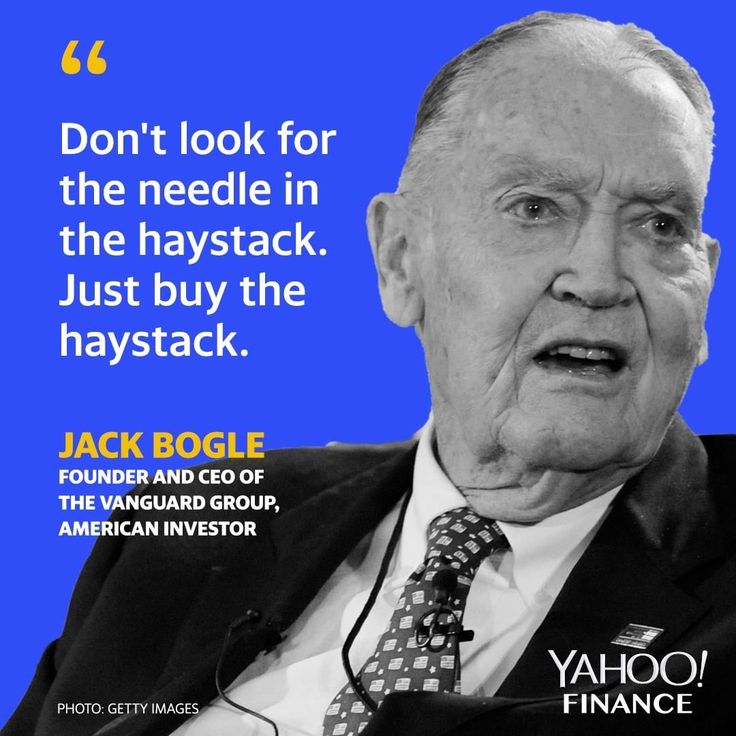
Source: Yahoo! Finance
Vanguard Group fundada por John C. Bogle en 1975 en Pensilvania, hoy en día el segundo gestor de activos del mundo con $9 billones de dólares bajo gestión, revolucionó la industria por dos razones:
Su particular estructura de propiedad.
El Santo Grial: El foco en los fondos indexados de bajo costo con su política de no-load.
Su estructura de propiedad es reconocida y aplaudida en el mundo entero por permitir a sus inversores ser dueños de la propia empresa. Vanguard es propiedad de sus fondos y, a su vez, los fondos son propiedad de los inversores. Esta estructura permite que se alineen incentivos y no haya conflictos, permitiendo así reducir costes, otra de las herramientas que han permitido a Vanguard posicionarse así. Sus clientes son sus accionistas. Por lo que una mayor parte de los ingresos generados por las inversiones permanece en manos de las personas que invierten.
Bogle quiso resolver la falta de democratización del acceso a la inversión y los altos costes que esta implicaba para el inversor.
En 1976 Vanguard lanzó el First Index Investment Trust, hoy conocido como Vanguard 500 Index Fund, un fondo indexado que, como dice su nombre, indexaba al S&P500, es decir, las 500 empresas más grandes de EEUU por capitalización de mercado, y aquí entran los dos riesgos del principio junto a la brillante idea de Bogle. Es importante destacar que la propuesta en su momento fue ridiculizada por simplemente ser “mediocridad garantizada”, pero esa supuesta mediocridad terminó cambiando la industria, definiendo la inversión pasiva, y demostrando el poder de la diversificación de la mano del tiempo. Bogle quitó a su vez los loads que otros gestores obligaban a los inversores a pagar para utilizar su servicio, facilitando así aún más al inversor particular la inversión.
Mediante un fondo indexado con bajos costes, un inversor puede reducir su exposición al riesgo idiosincrático a través de la diversificación al no concentrar todo en una sola empresa y/o sector.
Bogle provocó desde entonces lo que se conoce como el “Efecto Vanguard”: un cambio estructural en la industria que benefició no solo a los clientes de Vanguard, sino también al inversor medio, incluso aunque nunca comprara un solo producto de la firma.
Seis impactos del efecto Vanguard
1) La guerra de precios que cambió la industria
El primer impacto fue competitivo: si alguien puede ofrecer “el mercado” a muy bajo coste, el resto tiene que reaccionar. Desde 1975 hasta 2025, el ratio de gastos de Vanguard ha caído drásticamente del 0,68% al 0,06%, mientras que la industria pasó de 0,73% a 0,39% en el mismo periodo. Ese efecto de bajada de costes ha provocado el ahorro de miles de millones en costes y comisiones, siguiendo así la filosofía de Bogle de ayudar al inversor particular y democratizar el mercado.
2) En relación con lo anterior: democratización de la inversión
Antes del indexado barato, diversificar bien era caro y muchas veces inaccesible para el inversor pequeño. Con un fondo indexado, un ahorrador puede comprar exposición a cientos (o miles) de empresas en una sola posición, reduciendo el riesgo idiosincrático sin necesidad de “adivinar” ganadores.
Bogle convirtió una idea que era casi académica en un producto sencillo y replicable.
Comportamiento estable frente al timing
3) Disciplina contra el “market timing”
El tercer impacto es menos visible pero igual de importante: el indexado fomenta un comportamiento más estable. Si tu estrategia es “capturar el mercado” a bajo coste, el incentivo es aportar periódicamente, mantener y rebalancear, en lugar de perseguir modas o intentar entrar y salir.
4) Del “stock picking” al diseño de carteras
Del “stock picking” en 1975 a una conversación actual de qué está compuesta tu cartera. Los fondos indexados de renta variable junto a los posteriores de renta fija con los bonos, los ETFs y los actuales de Commodities, han permitido un cambio de mentalidad centrada en el horizonte de tiempo del inversor, su tolerancia al riesgo e incluso su afección por ciertos activos.
5) “No-load” y caída de fricciones de distribución
Además de la comisión anual, Bogle atacó otra gran fuga de rentabilidad: las fricciones de distribución. En las últimas décadas, la industria ha girado hacia fondos sin load: la ICI documenta que el descenso de comisiones y el cambio hacia fondos sin load ha sido una tendencia de largo recorrido, con una parte creciente de ventas concentrándose en productos “no-load”.
El benchmark como medida de referencia
6) Un benchmark, es decir, algo contra lo que medir y reaccionar
Bogle nos dio algo contra lo que medirnos, algo contra lo que demostrarnos ya sea mediante la gestión activa o pasiva nuestra calidad de decisiones y gestión de activos.
El uso de los fondos indexados como benchmark en el mundo de las inversiones se ha utilizado tanto que uno no puede pasar ni dos minutos en internet sin ver o leer una mención hacia este tipo de productos, habiéndose convertido así en parte de nuestra educación financiera, nuestra visión a largo plazo y nuestro mínimo como inversor.
Batir al mercado es básicamente batir a un índice, y eso nos lo enseñó Bogle a través de Vanguard y su filosofía.
To delve into this story, we first need to define several concepts to understand what we're working with:
Idiosyncratic risk: risk specific to a particular company, sector or asset. Poor management, strikes, legal problems, scandals, etc.
Systematic risk: synonymous with market risk. That risk which affects the entire market, the uncertainty of the geopolitical context, the macroeconomic state with inflation, interest rates, etc.
Vanguard and John C. Bogle's revolution
If one has read something about finance or has a small amount of knowledge, they will know that the word and/or definition that should come next is diversification, because through diversification an investor reduces their concentrated exposure to a particular sector, asset or industry…. And that is where the story of Vanguard and John C. Bogle comes in.
In the context of its birth, the financial industry was dominated by high-cost stock picking strategies, something that slowly but relentlessly ate away at small investors. It was those maintenance costs, which seemed small at an average of 0.73%, and those more lucrative subscription costs of an average 8%, that nibbled away at the individual investor's portfolio. Silent termites that left the investor unprotected and without any choice. That's when Vanguard and the dear Bogle came in.
Source: Yahoo! Finance
Vanguard Group founded by John C. Bogle in 1975 in Pennsylvania, today the world's second largest asset manager with $9 trillion under management, revolutionized the industry for two reasons:
Its particular ownership structure.
The Holy Grail: The focus on low-cost index funds with its no-load policy.
Its ownership structure is recognized and applauded throughout the world for allowing its investors to own the company itself. Vanguard is owned by its funds and, in turn, the funds are owned by the investors. This structure allows incentives to align and prevents conflicts, thus making it possible to reduce costs, another of the tools that has allowed Vanguard to position itself as it has. Its customers are its shareholders. So a greater portion of the income generated by the investments remains in the hands of the people who invest.
Bogle wanted to solve the lack of democratization of access to investment and the high costs that this entailed for the investor.
In 1976 Vanguard launched the First Index Investment Trust, today known as Vanguard 500 Index Fund, an index fund that, as its name says, indexed the S&P 500, that is, the 500 largest companies in the US by market capitalization, and here the two risks from the beginning come in along with Bogle's brilliant idea. It is important to note that the proposal at the time was ridiculed for simply being "guaranteed mediocrity", but that supposed mediocrity ended up changing the industry, defining passive investing, and demonstrating the power of diversification over time. Bogle also removed the loads that other managers forced investors to pay to use their service, thus making it even easier for the average investor to invest.
Through an index fund with low costs, an investor can reduce their exposure to idiosyncratic risk through diversification by not concentrating everything in a single company and/or sector.
Bogle has since provoked what is known as the "Vanguard Effect": a structural change in the industry that benefited not only Vanguard's customers, but also the average investor, even if they never bought a single product from the firm.
Six impacts of the Vanguard Effect
1) The price war that changed the industry
The first impact was competitive: if someone can offer "the market" at very low cost, everyone else has to react. From 1975 to 2025, Vanguard's expense ratio has fallen dramatically from 0.68% to 0.06%, while the industry went from 0.73% to 0.39% in the same period. This cost reduction effect has resulted in savings of billions in costs and commissions, thus following Bogle's philosophy of helping the average investor and democratizing the market.
2) In relation to the above: democratization of investment
Before cheap indexing, diversifying well was expensive and often inaccessible to the small investor. With an index fund, a saver can buy exposure to hundreds (or thousands) of companies in a single position, reducing idiosyncratic risk without needing to "guess" winners.
Bogle turned an idea that was almost academic into a simple and replicable product.
Stable behavior against market timing
3) Discipline against "market timing"
The third impact is less visible but equally important: indexing encourages more stable behavior. If your strategy is to "capture the market" at low cost, the incentive is to contribute periodically, maintain and rebalance, rather than chase fads or try to time the market.
4) From "stock picking" to portfolio design
From "stock picking" in 1975 to a current conversation about what your portfolio is made up of. Equity index funds together with later fixed income funds with bonds, ETFs and current commodity funds, have allowed a shift in mindset focused on the investor's time horizon, their risk tolerance and even their preference for certain assets.
5) "No-load" and the fall of distribution frictions
In addition to the annual commission, Bogle attacked another major leak in returns: distribution frictions. In recent decades, the industry has shifted towards no-load funds: the ICI documents that the decline in commissions and the shift towards no-load funds has been a long-term trend, with a growing share of sales concentrated in "no-load" products.
The benchmark as a reference measure
6) A benchmark, that is, something to measure against and react to
Bogle gave us something to measure ourselves against, something against which to demonstrate to ourselves whether through active or passive management our quality of decisions and asset management.
The use of index funds as a benchmark in the world of investments has been used so much that one cannot go two minutes on the internet without seeing or reading a mention of this type of product, having thus become part of our financial education, our long-term vision and our minimum as an investor.
Beating the market is basically beating an index, and that's what Bogle taught us through Vanguard and its philosophy.
Compártelo en tu historia
- Descarga la imagen.
- Súbela a tu historia de Instagram.
- Añade el sticker de enlace y pega el del artículo: ya lo tienes copiado.