El Capture Ratio y su utilidad como herramienta en la comparación de fondos de inversión
¿Cómo deberían evaluarse los fondos de inversión adecuadamente?
“Este fondo es espectacular, cae menos en las caídas y sube más en los mercados alcistas”. Frases como esta son frecuentemente escuchadas entre profesionales y aficionados a la inversión. No obstante, detrás de esa afirmación existe una métrica que, sin ser demasiado conocida fuera del mundo profesional, resulta muy útil para evaluar el comportamiento de un fondo de inversión: el Capture Ratio.
Qué es el Capture Ratio y cómo funciona
A diferencia de otras métricas más extendidas como el ratio de Sharpe o la mismísima volatilidad, el capture ratio no se centra tanto en el riesgo total asumido, sino en cómo se comporta un fondo en relación a su índice de referencia en las diferentes fases del mercado. En otras palabras, responde a la pregunta: ¿mi fondo se comporta mejor o peor que su índice cuando el mercado sube o baja?
Es por tanto que el cálculo del capture ratio distingue entre periodos alcistas y bajistas, comparando siempre el comportamiento del fondo frente a su índice de referencia de la siguiente manera:
Upside Capture Ratio = (Fund Return during Bullish Periods/Benchmark Return during Bullish Periods) * 100
Downside Capture Ratio = (Fund Return during Bearish Periods/Benchmark Return during Bearish Periods) * 100
Por consiguiente, un valor superior a 100 en el caso alcista interpreta que el fondo lo hace mejor que el índice cuando los mercados suben. En cambio, en el caso bajista, un ratio por debajo de 100 refleja que el fondo cae menos que el índice, lo que implica una mayor protección en fases negativas.
Por qué es importante esta métrica
¿Por qué es importante esta métrica? Porque permite ir más allá de la rentabilidad agregada y analizar la consistencia del fondo. Dos fondos estudiados en el mismo intervalo de tiempo pueden arrojar la misma rentabilidad acumulada, pero uno de ellos quizá haya protegido mucho mejor en caídas, generando un camino de inversión menos doloroso para el inversor. Este matiz es de vital importancia, pues buena parte de los errores cometidos por los inversores se producen por decisiones emocionales en momentos de mercados bajistas.
Comparación de fondos: un ejemplo práctico
Comparación de fondos: un ejemplo práctico
Dicho esto y desde el punto de vista práctico, cabe recalcar que el capture ratio es una herramienta complementaria dentro del análisis de fondos. No sustituye por tanto a otras métricas, pero aporta una información muy relevante sobre la calidad de la gestión y además, permite hacer comparaciones entre fondos que siguen un mismo índice de referencia.
Por ejemplo, escojamos como referencia dos fondos cuyo índice de referencia sea el MSCI World NR USD y analicemos su desempeño durante los últimos 5 años en base al capture ratio. Para ello se han recopilado los siguientes datos de la base de datos de Morningstar:
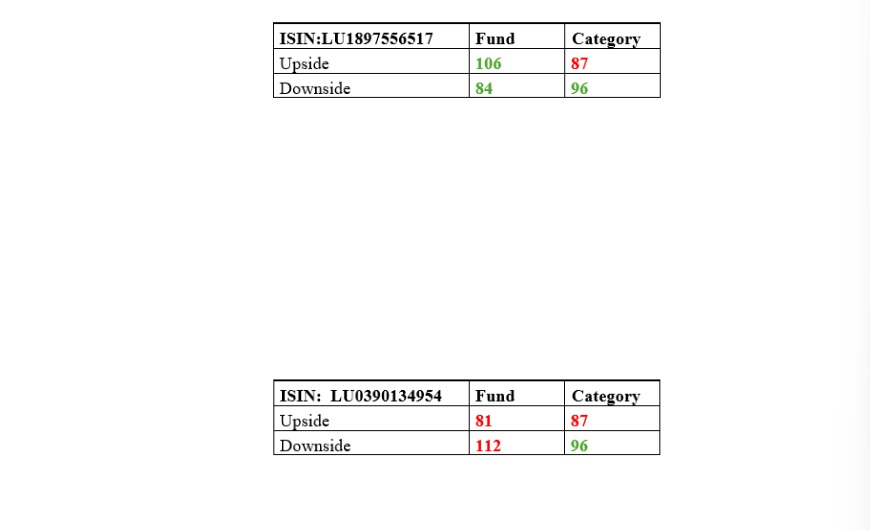
Fuente: global.morningstar.com
Interpretación de los datos obtenidos:
Fondo A:
- Upside Capture 106 → en meses de mercado alcista, el fondo capta el 106% de la subida del índice (es decir, lo hace ligeramente mejor que el benchmark).
- Downside Capture 84 → en meses bajistas, el fondo participa solo en el 84% de la caída del índice (protegiendo al inversor frente a pérdidas).
- Conclusión: este fondo muestra un comportamiento eficiente, capturando más las subidas y reduciendo las pérdidas en caídas.
Fondo B:
- Upside Capture 81 → en meses de mercado alcista, el fondo solo capta el 81% de la subida del índice (se queda rezagado frente al benchmark).
- Downside Capture 112 → en meses bajistas, el fondo sufre el 112% de la caída del índice (pierde más de lo que cae el benchmark).
- Conclusión: este fondo presenta un desempeño menos favorable, capturando menos las subidas y sufriendo más en las bajadas.
Limitaciones y consideraciones finales
En definitiva, el capture ratio es una herramienta muy útil para evaluar cómo un fondo se comporta frente a su índice en fases alcistas y bajistas, pero no debe utilizarse de forma aislada durante el análisis de fondos. Debemos recordar que su fiabilidad depende del periodo analizado (cuanto mayor sea mejor), del benchmark elegido y de la consistencia del estilo del fondo; por eso, siempre conviene interpretarlo junto con otros indicadores y revisando distintos horizontes temporales.
Además, es importante recalcar que no tiene poder predictivo. Un buen capture ratio en el pasado no garantiza que el fondo mantenga ese comportamiento en el futuro. Tampoco refleja el riesgo total, los costes, ni cambios en la gestión o la filosofía de inversión, factores que pueden modificar significativamente el vehículo de inversión.
“This fund is spectacular, it falls less during market declines and rises more in bull markets.” Phrases like this are often heard among finance professionals and investment enthusiasts. However, behind this statement lies a metric that, while not widely known outside professional circles, is very useful for evaluating a fund’s performance: the Capture Ratio.
What Is the Capture Ratio and How It Works
Unlike other more commonly used metrics such as the Sharpe ratio or volatility, the capture ratio does not focus on the total risk assumed, but rather on how a fund behaves in relation to its benchmark in different market phases. In other words, it answers the question: does my fund perform better or worse than its index when the market goes up or down?
The calculation of the capture ratio distinguishes between bullish and bearish periods, always comparing the fund’s performance against its benchmark as follows:
Upside Capture Ratio = (Fund Return during Bullish Periods/Benchmark Return during Bullish Periods) * 100
Downside Capture Ratio = (Fund Return during Bearish Periods/Benchmark Return during Bearish Periods) * 100
A value above 100 in bullish periods indicates that the fund performs better than the index when markets rise. Conversely, in bearish periods, a ratio below 100 shows that the fund falls less than the index, providing greater protection during negative phases.
Why This Metric Is Important
Why This Metric Is Important
It allows investors to look beyond aggregated returns and analyze the fund’s consistency. Two funds over the same period may show similar cumulative returns, but one may have provided much better protection during market declines, creating a less painful investment journey. This nuance is crucial, as many investment mistakes are made due to emotional decisions during bearish market phases.
Comparing Funds: A Practical Example
Comparing Funds: A Practical Example
From a practical standpoint, the capture ratio is a complementary tool in fund analysis. It does not replace other metrics but provides highly relevant information about management quality and allows comparisons between funds that follow the same benchmark.
For example, let’s consider two funds whose benchmark is the MSCI World NR USD, analyzing their performance over the past five years based on the capture ratio. The following data has been collected from the Morningstar database:
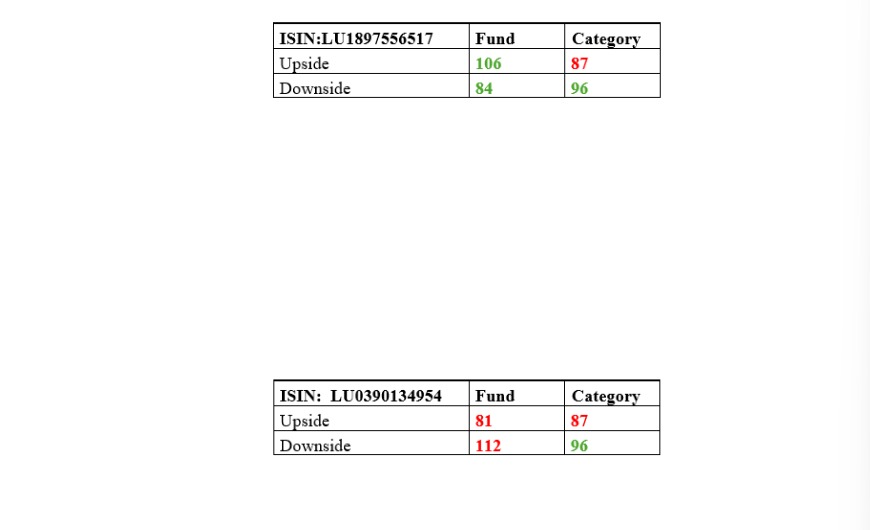
Source: global.morningstar.com
Interpretation of the Data
Fund A (LU1897556517):
- Upside Capture 106 → in bullish months, the fund captures 106% of the index’s gain. For example, if the index rises 10%, the fund would rise approximately 10.6%.
- Downside Capture 84 → in bearish months, it participates in only 84% of the index’s decline, providing better protection for the investor.
- Conclusion: the fund demonstrates efficient behavior, capturing more on the upside while limiting losses on the downside.
Fund B (LU0390134954):
- Upside Capture 81 → captures only 81% of the index’s gain, lagging behind the benchmark.
- Downside Capture 112 → suffers 112% of the index’s decline, meaning it falls more than the benchmark.
- Conclusion: this fund shows less favorable performance, capturing less in up markets and losing more in down markets.
Limitations and Final Considerations
Final Considerations
In summary, the capture ratio is a very useful tool for evaluating how a fund behaves relative to its benchmark during bullish and bearish periods, but it should not be used in isolation. Its reliability depends on the period analyzed (longer periods generally provide better insights), the chosen benchmark, and the fund’s style consistency. Therefore, it should always be interpreted alongside other indicators and across different time horizons.
It is also important to note that the capture ratio does not have predictive power. A strong historical capture ratio does not guarantee that a fund will maintain that performance in the future. It also does not reflect total risk, costs, or changes in management or investment philosophy, factors that can significantly affect the fund’s outcomes.
Compártelo en tu historia
- Descarga la imagen.
- Súbela a tu historia de Instagram.
- Añade el sticker de enlace y pega el del artículo: ya lo tienes copiado.