El mercado le puso precio de funeral al software
Los números dicen otra cosa
Si tuvieras que decidir hoy dónde poner tu dinero dentro de la tecnología, ¿comprarías una acción de software después de que el mercado la haya calificado como la próxima víctima de la IA, o comprarías semiconductores en máximos históricos por la narrativa que el mercado tiene con la IA? La mayoría de los inversores ha dicho que no al software durante buena parte de 2026. Y sin embargo, los informes trimestrales que estas mismas compañías han publicado en las últimas semanas cuentan una historia bastante distinta a la del pánico que llevaba meses instalado en sus cotizaciones.
Empecemos por el origen del miedo. A principios de año, el lanzamiento de nuevas herramientas de agentes de IA capaces de ejecutar flujos de trabajo complejos —desde análisis hasta gestión de clientes— disparó lo que Wall Street bautizó como la “SaaSpocalypse”. La tesis era sencilla y aterradora para cualquier accionista de software: si un agente de IA puede hacer el trabajo de varios usuarios, o si cualquier competidor puede replicar una aplicación con un simple prompt, el modelo de negocio que ha sostenido el crecimiento del sector durante una década se rompe. El resultado fue una purga histórica: el índice SEG SaaS, que agrupa a más de 120 compañías cotizadas, llegó a caer más de un 25% en el primer trimestre, y se estima que el sector borró en torno a dos billones de dólares de capitalización en doce meses.
Salesforce (NYSE:CRM) llegó a estar un 40% abajo en el año; Adobe (NASDAQ:ADBE) acumula una caída máxima cercana al 70% desde sus máximos históricos de 2024; Constellation Software (TSX:CSU) ha llegado a cotizar más de un 55% por debajo de sus máximos; y ServiceNow (NYSE:NOW) llegó a caer más de un 60% desde sus picos. El problema es que, mientras el precio caía, los fundamentales no lo hicieron. Ahí está la desconexión que, a mi juicio, el mercado sigue sin corregir del todo.
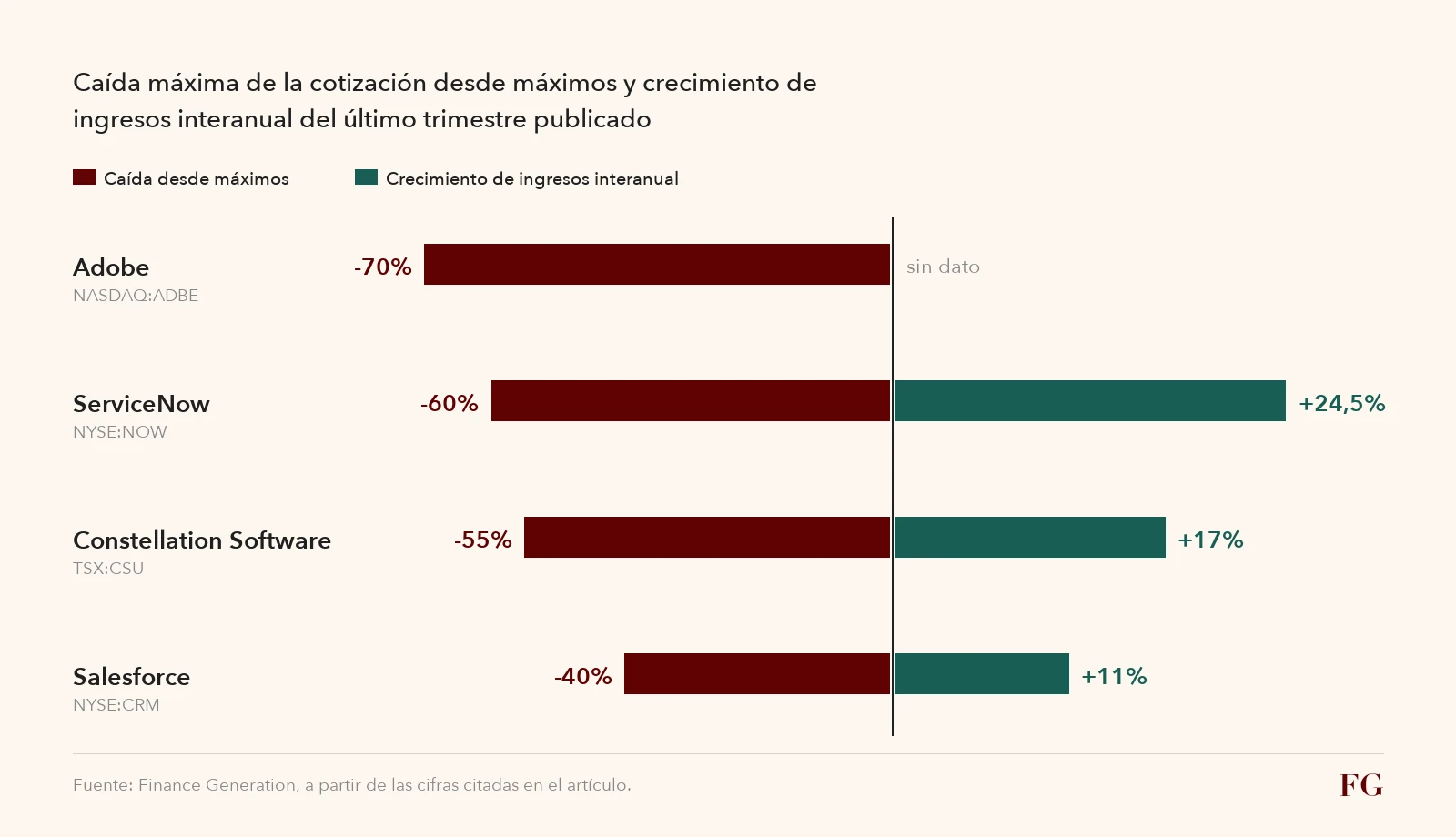
Fuente: Finance Generation, a partir de las cifras citadas en el artículo.
Salesforce: la nube que se defiende integrando IA
Salesforce publicó su segundo trimestre del año fiscal (cerrado el 31 de julio) con unos ingresos de 11.350 millones de dólares, un 11% más interanual y por encima del consenso de LSEG. El beneficio por acción ajustado se disparó a 5,90 dólares frente a los 3,27 dólares esperados por el mercado. La compañía elevó su guidance de ingresos anuales y anunció una ampliación de su alianza con Anthropic bajo el nombre de “Claudeforce”, precisamente para integrar IA dentro de su propia plataforma en lugar de ser sustituida por ella. El propio consejero delegado, Marc Benioff, fue directo en la conferencia con analistas al calificar de “sinsentido” la narrativa de la SaaSpocalypse y afirmar que “es hora de que termine”. El mercado, por su parte, respondió con una subida de en torno al 23% en la cotización al día siguiente del informe, lo que demuestra la falta de fortaleza de esa narrativa en el sector del software.
Constellation Software: el moat que el “vibe coding” no cruza
Constellation Software es el ejemplo menos conocido fuera de Canadá, pero quizá el más interesante para entender el error de valoración del mercado. La tesis bajista aquí no es que la IA sustituya usuarios, sino que el “vibe coding” (programar con lenguaje natural) abarate tanto el desarrollo de software que cualquier competidor pueda replicar en semanas las aplicaciones verticales muy específicas que Constellation lleva treinta años comprando y consolidando. En su segundo trimestre de 2026, la compañía facturó 3.335 millones de dólares, un 17% más interanual, con un margen EBITA del 25,2% y un beneficio neto que se disparó un 386% por efectos cambiarios y de revaluación de pasivos. Es cierto que el crecimiento orgánico se ha desacelerado a apenas un 1% en moneda constante, su nivel más débil en casi seis años (recordemos que Constellation Software presenta un modelo de crecimiento tipo rollup, basado en adquisiciones recurrentes de compañías de software vertical, lo que hace que parte del crecimiento sea de manera inorgánica), y esa desaceleración es algo que además la propia dirección atribuye a comparativas exigentes, ruido contable puntual en alguna de sus unidades y la pérdida de un cliente concreto, no a la IA. De hecho, la propia compañía sostiene que la IA está aumentando su productividad de desarrollo interno más de lo que está erosionando su negocio, porque sus verdaderos activos —tres décadas de datos propietarios, cumplimiento normativo y relaciones con clientes en sectores muy regulados— no son tan fáciles de replicar como una interfaz. Morningstar elevó recientemente su calificación de la acción de 4 a 5 estrellas.
ServiceNow: la renovación al 98% que desmiente el pánico
ServiceNow, la compañía que en teoría debería estar más expuesta por su modelo de flujos de trabajos empresariales, presentó quizá el resultado más contundente del grupo: ingresos por suscripción de 3.877 millones de dólares, un 24,5% más interanual, con el valor contractual anual ligado a IA superando ya los 1.000 millones de dólares y los despliegues de agentes de IA multiplicándose por nueve en apenas nueve meses. La compañía elevó su guidance de ingresos por suscripción para el conjunto de 2026 hasta 15.760-15.780 millones de dólares, un crecimiento del 22,5%. Mantiene además una tasa de renovación del 98%, la prueba más directa de que sus clientes no están sustituyendo la plataforma por un agente propio. El único punto negativo de los últimos resultados es que el beneficio neto contable (GAAP) cayó cerca de un 23% interanual, lastrado por la amortización de intangibles y los costes ligados a adquisiciones; el beneficio ajustado (no-GAAP), en cambio, sí creció.
En los cuatro casos se repite el mismo patrón: la IA no está vaciando el negocio de estas compañías, sino que se está convirtiendo en una línea de ingresos adicional que crece más rápido que el negocio tradicional, o bien, como en Constellation, en una herramienta que refuerza un foso competitivo que ya existía por otras razones.
¿Por qué, entonces, sigue cayendo el sector después de todos estos meses si aparentemente los números son buenos? En parte porque el riesgo de disrupción por IA es, por definición, estructural y no se refleja todavía en las métricas actuales: una compañía puede lucir sana en sus cuentas de hoy mientras el terreno se mueve bajo sus pies de cara a los próximos tres o cinco años, y eso genera un descuento. Pero también porque el mercado extrapoló el titular más dramático —“la IA sustituye usuarios”, “cualquiera puede copiar tu software con un prompt”— sin distinguir entre compañías que compiten con la IA en igualdad de condiciones y compañías que están monetizándola dentro de su propio negocio o protegidas por fosos que ninguna IA generativa resuelve de la noche a la mañana, como los datos propietarios o el cumplimiento normativo. No es que todas las empresas de software vayan a desaparecer, ni que todas sean oportunidades de inversión solo porque cotizan a múltiplos más bajos: hay que analizar el modelo de negocio de cada una, los números, la cotización y si un simple prompt sería capaz de borrar años de datos, relaciones con clientes y confianza acumulada. Ahí, precisamente, está la oportunidad del sector.
No es casualidad que analistas de JPMorgan calificaran la lógica del desplome como “rota” ni que Morgan Stanley recomendara comprar nueve valores de software “con descuento” tras el batacazo. Eso no significa que el riesgo de la IA sobre el software sea inexistente —sería ingenuo afirmarlo, y Adobe es la prueba de que el mercado seguirá exigiendo pruebas trimestre a trimestre—, sino que se castigó de forma indiscriminada a compañías con perfiles muy distintos. Salesforce, Adobe, Constellation Software y ServiceNow, entre muchas otras, no se defienden de la IA de la misma manera, pero ninguna de las cuatro está siendo devorada por ella.
Qué mirar a partir de aquí
Como primer paso y sin ser ninguna recomendación de inversión, evitaría los dos extremos: ni comprar el sector en bloque solo porque cotiza barato, ni descartarlo en bloque por la etiqueta de “software amenazado por la IA”. Conviene fijarse en tres señales concretas antes de tomar una posición. Primera, la tasa de renovación de clientes: por encima del 95%, como en ServiceNow, es la prueba más directa de que el negocio de momento no se está sustituyendo por un agente propio. Segunda, el peso que la IA ya representa dentro de la actividad de la empresa y su ritmo de crecimiento frente al negocio tradicional; si crece varias veces más rápido, como en los cuatro casos analizados, es una señal a favor y no una amenaza. Y tercera, el foso competitivo real de cada compañía (moat) —datos propietarios, cumplimiento normativo, coste de cambiar de proveedor— frente a herramientas que un competidor podría replicar con un simple prompt. Finalmente los próximos resultados del Q3 y Q4 del sector mostrarán si siguen la tendencia que han seguido en los anteriores en la mayoría de las empresas mencionadas y serán en este sentido la prueba de fuego para todo el sector: si logran estabilizar el crecimiento de su ARR digital, buena parte de la narrativa bajista se quedará sin argumentos.
If you had to decide today where to put your money within technology, would you buy a software stock after the market has labelled it the next victim of AI, or would you buy semiconductors at all-time highs on the back of the market’s AI narrative? Most investors have said no to software for a good part of 2026. And yet the quarterly reports these very companies have published in recent weeks tell a rather different story from the panic that had been embedded in their share prices for months.
Let’s start with the source of the fear. At the beginning of the year, the launch of new AI agent tools capable of carrying out complex workflows —from analysis to customer management— triggered what Wall Street dubbed the “SaaSpocalypse”. The thesis was simple and terrifying for any software shareholder: if an AI agent can do the work of several users, or if any competitor can replicate an application with a simple prompt, the business model that has sustained the sector’s growth for a decade breaks down. The result was a historic purge: the SEG SaaS index, which groups more than 120 listed companies, fell by more than 25% at one point in the first quarter, and the sector is estimated to have wiped out around two trillion dollars of market capitalisation in twelve months.
Salesforce (NYSE:CRM) was at one point down 40% on the year; Adobe (NASDAQ:ADBE) has suffered a maximum drawdown of close to 70% from its 2024 all-time highs; Constellation Software (TSX:CSU) has traded more than 55% below its highs; and ServiceNow (NYSE:NOW) fell more than 60% from its peaks at one point. The problem is that, while the price was falling, the fundamentals were not. That is the disconnect which, in my view, the market has still not fully corrected.
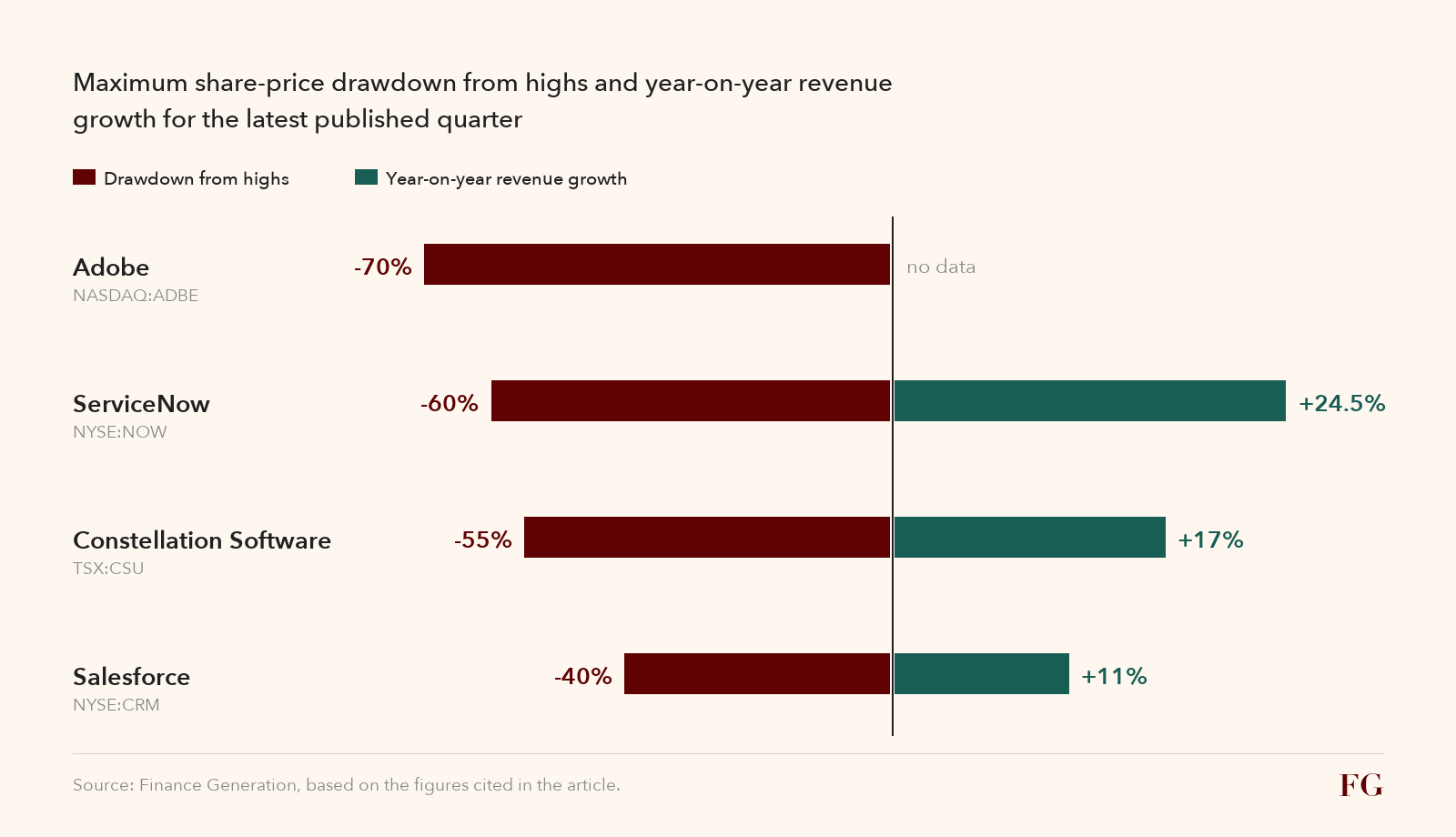
Source: Finance Generation, based on the figures cited in the article.
Salesforce: the cloud that defends itself by integrating AI
Salesforce reported the second quarter of its fiscal year (ended 31 July) with revenue of $11,350 million, up 11% year on year and above the LSEG consensus. Adjusted earnings per share soared to $5.90, against the $3.27 expected by the market. The company raised its annual revenue guidance and announced an expansion of its alliance with Anthropic under the name “Claudeforce”, precisely in order to integrate AI into its own platform rather than be replaced by it. Chief executive Marc Benioff himself was blunt on the analyst call, calling the SaaSpocalypse narrative “nonsense” and saying that “it is time for it to end”. The market, for its part, responded with a rise of around 23% in the share price the day after the report, which shows how little strength that narrative has in the software sector.
Constellation Software: the moat that “vibe coding” cannot cross
Constellation Software is the least-known example outside Canada, but perhaps the most interesting for understanding the market’s valuation error. The bearish thesis here is not that AI replaces users, but that “vibe coding” (programming in natural language) makes software development so cheap that any competitor could replicate in weeks the highly specific vertical applications that Constellation has spent thirty years buying and consolidating. In its second quarter of 2026, the company had revenue of $3,335 million, up 17% year on year, with an EBITA margin of 25.2% and net income that soared 386% due to currency effects and the revaluation of liabilities. It is true that organic growth has slowed to just 1% in constant currency, its weakest level in almost six years (remember that Constellation Software has a rollup-type growth model, based on recurring acquisitions of vertical software companies, which means that part of its growth is inorganic), and management itself attributes that slowdown to demanding comparisons, one-off accounting noise in some of its units and the loss of a specific customer, not to AI. In fact, the company itself maintains that AI is increasing its internal development productivity more than it is eroding its business, because its real assets —three decades of proprietary data, regulatory compliance and customer relationships in highly regulated sectors— are not as easy to replicate as an interface. Morningstar recently raised its rating on the stock from 4 to 5 stars.
ServiceNow: the 98% renewal rate that belies the panic
ServiceNow, the company that in theory should be most exposed because of its business-workflow model, delivered perhaps the most compelling results of the group: subscription revenue of $3,877 million, up 24.5% year on year, with AI-linked annual contract value already exceeding $1,000 million and AI agent deployments multiplying ninefold in just nine months. The company raised its subscription revenue guidance for 2026 as a whole to $15,760-15,780 million, growth of 22.5%. It also maintains a renewal rate of 98%, the most direct proof that its customers are not replacing the platform with an in-house agent. The only negative point in the latest results is that accounting net income (GAAP) fell by about 23% year on year, weighed down by the amortisation of intangibles and acquisition-related costs; adjusted earnings (non-GAAP), on the other hand, did grow.
In all four cases the same pattern repeats: AI is not hollowing out these companies’ business, but rather becoming an additional revenue line that grows faster than the traditional business, or, as at Constellation, a tool that reinforces a competitive moat that already existed for other reasons.
Why, then, does the sector keep falling after all these months if the numbers are apparently good? Partly because the risk of AI disruption is, by definition, structural and is not yet reflected in current metrics: a company can look healthy in today’s accounts while the ground shifts beneath its feet over the next three to five years, and that creates a discount. But also because the market extrapolated the most dramatic headline —“AI replaces users”, “anyone can copy your software with a prompt”— without distinguishing between companies that compete with AI on equal terms and companies that are monetising it within their own business or are protected by moats that no generative AI can overcome overnight, such as proprietary data or regulatory compliance. It is not that all software companies are going to disappear, nor that they are all investment opportunities just because they trade at lower multiples: you have to analyse each one’s business model, the numbers, the share price and whether a simple prompt would be capable of wiping out years of data, customer relationships and accumulated trust. That, precisely, is where the opportunity in the sector lies.
It is no coincidence that JPMorgan analysts described the logic of the sell-off as “broken”, or that Morgan Stanley recommended buying nine software stocks “at a discount” after the slump. That does not mean the risk AI poses to software is non-existent —it would be naive to claim so, and Adobe is proof that the market will keep demanding evidence quarter after quarter— but rather that companies with very different profiles were punished indiscriminately. Salesforce, Adobe, Constellation Software and ServiceNow, among many others, do not defend themselves against AI in the same way, but none of the four is being devoured by it.
What to watch from here
As a first step, and without this being any kind of investment recommendation, I would avoid both extremes: neither buying the sector wholesale just because it is cheap, nor dismissing it wholesale because of the “software threatened by AI” label. It is worth looking at three specific signals before taking a position. First, the customer renewal rate: above 95%, as at ServiceNow, it is the most direct proof that the business is not, for now, being replaced by an in-house agent. Second, the weight AI already represents within the company’s activity and its pace of growth compared with the traditional business; if it is growing several times faster, as in the four cases analysed, it is a positive sign and not a threat. And third, each company’s real competitive moat —proprietary data, regulatory compliance, the cost of switching provider— compared with tools that a competitor could replicate with a simple prompt. Finally, the sector’s upcoming Q3 and Q4 results will show whether most of the companies mentioned continue the trend they followed in previous quarters, and in that sense they will be the acid test for the whole sector: if they manage to stabilise the growth of their digital ARR, much of the bearish narrative will run out of arguments.
Compártelo en tu historia
- Descarga la imagen.
- Súbela a tu historia de Instagram.
- Añade el sticker de enlace y pega el del artículo: ya lo tienes copiado.