Nvidia corta el cable
Cuando pensamos en el futuro de la inteligencia artificial, a todos se nos viene la misma idea a la cabeza: chips más potentes. Pero ¿y si el mayor cuello de botella de la IA no fuera la potencia de los chips, sino el cable que los une?
Nvidia ya va un paso por delante y, por eso, acaba de poner en producción una tecnología que sustituye el cobre por luz para mover los datos entre GPUs. No es un experimento de laboratorio ni una idea futurista, sino que ya es la base de sus plataformas de red más avanzadas.
Lo que hace interesante este movimiento no es solo la tecnología en sí, sino a quién arrastra con ella. Nvidia no está compitiendo únicamente por vender más GPUs; está intentando controlar también las “tuberías” que las conectan, y para ello ha convertido a fabricantes de componentes ópticos en piezas clave de la cadena de valor de la IA.
El límite físico que nadie quería aceptar
Para tener un poco más de contexto, las GPUs (Graphics Processing Unit) son los chips que procesan los cálculos de la inteligencia artificial. Cuantas más tengas trabajando a la vez, más rápido entrenas y ejecutas un modelo.
Durante años, la trayectoria de la IA se ha medido en número de GPUs y en potencia de cálculo. Pero entrenar modelos cada vez más grandes exige algo menos intuitivo a primera vista; que miles de esas GPUs se comuniquen entre sí a toda velocidad, constantemente. Y ahí es donde el cobre empieza a fallar, ya que de poco sirve tener miles de ellas si no pueden hablar entre sí con la suficiente rapidez.
Cuanto más rápido intentas mover datos por un cable de cobre, más calor generas y más energía se pierde por el camino, en forma de resistencia eléctrica. Dicho de forma sencilla, es como si en una carretera estrecha quisieras meter más coches de los que caben. Al final, se forma un atasco y cada coche avanza menos. Por no hablar de la gasolina que gastan sin apenas moverse.
El problema no es solo técnico, es también energético. Según la Agencia Internacional de la Energía, los centros de datos podrían consumir en 2030 alrededor de 945 teravatios-hora al año. Para que os hagáis una idea, esa cifra es comparable al consumo eléctrico total de un país como Japón. Y mientras el cobre siga siendo la única opción, la factura energética no tiene más remedio que subir.
La solución: mover datos con fotones, no con electrones
La apuesta de Nvidia consiste en sustituir la señal eléctrica por pulsos de luz para transportar la información entre GPUs. El cobre usa electrones; la luz, fotones. Y ahí está la clave; los electrones chocan entre sí y con el propio material por el que viajan, lo que genera calor y frena la señal. Los fotones, en cambio, viajan en paralelo sin estorbarse.
Hay tres razones por las que esto cambia las reglas del juego.
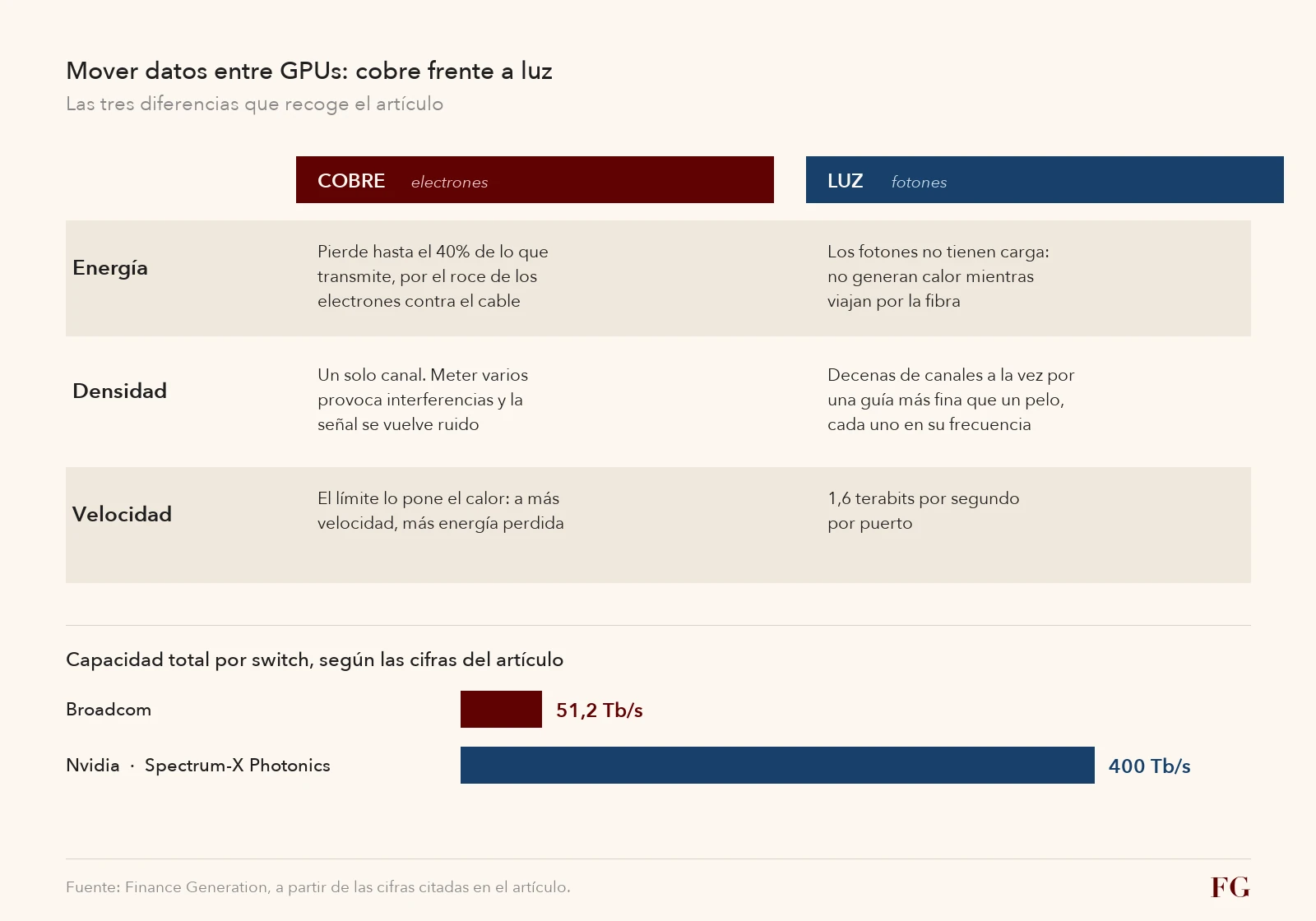
La primera es la eficiencia energética. Los fotones no tienen carga eléctrica, así que no generan calor mientras viajan por la fibra. El cobre, en cambio, puede perder hasta un 40% de la energía que intenta transmitir solo por el roce de los electrones contra el propio cable.
La segunda es la densidad de datos. Por una sola guía de onda, más fina que un pelo, pueden viajar simultáneamente decenas de canales de información, cada uno codificado en una frecuencia de luz distinta. Es parecido a la radio; puedes tener decenas de emisoras sonando a la vez en el mismo aire, cada una en su propia frecuencia, sin que se mezclen ni se pisen entre sí. Con el cobre, intentar algo así provoca las conocidas interferencias entre señales, algo parecido a que varias emisoras se solaparan en la misma frecuencia. ¿El resultado? En vez de escuchar una con claridad, acabarías oyendo un ruido confuso de todas mezcladas.
Con luz, en cambio, no hay de qué preocuparse; cada “frecuencia” viaja por su propio carril sin chocar con las demás.
La tercera es la velocidad. Los nuevos switches fotónicos de Nvidia, presentados bajo los nombres Spectrum-X Photonics y Quantum-X Photonics, alcanzan 1,6 terabits por segundo por puerto. Para que os hagáis una idea de la magnitud: eso equivale a mover el contenido completo de varias plataformas de streaming en cuestión de segundos, de forma continua y multiplicado por cada uno de los miles de puertos de un centro de datos.
Fuente: Finance Generation, a partir de las cifras citadas en el artículo.
De la teoría a la realidad
Esto ya no es una idea futurista. Nvidia ha confirmado que estos switches fotónicos forman parte de su infraestructura de red actual, pensada para que más de 10.000 GPUs puedan comunicarse entre sí sin que ninguna tenga que esperar su turno. Además, ha respaldado la apuesta con miles de millones de dólares invertidos en proveedores como Corning, Coherent y Lumentum para asegurarse el suministro de componentes ópticos.
España tampoco se ha quedado fuera. El Gobierno ha adjudicado 62,1 millones de euros al ICFO (Instituto de Ciencias Fotónicas), la Universidad Politécnica de Valencia, el Centro Nacional de Microelectrónica y la Universidad de Vigo para investigar y fabricar chips fotónicos, dentro de un programa europeo de fotónica. Por si fuera poco, gracias a la financiación de la Comisión Europea, que iguala la aportación española, la iniciativa movilizará en total 124,2 millones de euros.
Por qué es importante
El mercado ya le ha puesto precio a esta apuesta. Cuando Nvidia confirmó sus inversiones de 2.000 millones de dólares en Lumentum y otros 2.000 millones en Coherent, las acciones de ambas subieron el mismo día. Lumentum, que fabrica los láseres y componentes ópticos que alimentan estos centros de datos, ha llegado a revalorizarse más de un 1.000% en el último año, en gran parte gracias a su papel como proveedor clave de Nvidia. Coherent, por otro lado, encadenó trimestres de ingresos récord incluso antes de que se cerrara el acuerdo, lo que nos indica la fuerte demanda.
Aunque todo parezca ir a favor de Nvidia, no es la única jugando esta partida. Broadcom, su gran rival en chips personalizados, lleva años desarrollando sus propios switches ópticos, con una capacidad total de 51,2 terabits por segundo por switch; muy por debajo de los 400 terabits por segundo que promete Nvidia con sus switches Spectrum-X Photonics. Marvell tampoco se queda atrás, ha invertido miles de millones en compras como Celestial AI y ha firmado con Nvidia un acuerdo de colaboración en fotónica de silicio, aunque siguen compitiendo cara a cara en otros frentes del negocio.
Y esa es, en definitiva, la verdadera batalla: el crecimiento de la IA ya no depende solo de fabricar chips más potentes, sino de quién resuelve antes cómo comunicarlos entre sí. En esa carrera silenciosa por la infraestructura, la luz ha dejado de ser una curiosidad de laboratorio para convertirse en la apuesta que puede decidir quién sigue creciendo y quién se queda sin margen.
When we think about the future of artificial intelligence, the same idea comes to everyone’s mind: more powerful chips. But what if AI’s biggest bottleneck were not the power of the chips, but the cable that connects them?
Nvidia is already one step ahead and, for that reason, has just put into production a technology that replaces copper with light to move data between GPUs. It is not a laboratory experiment or a futuristic idea; it is already the foundation of its most advanced networking platforms.
What makes this move interesting is not only the technology itself, but who it drags along with it. Nvidia is not just competing to sell more GPUs; it is also trying to control the “pipes” that connect them, and to do so it has turned optical component manufacturers into key pieces of the AI value chain.
The physical limit nobody wanted to accept
For a little more context, GPUs (Graphics Processing Units) are the chips that process the calculations of artificial intelligence. The more of them you have working at the same time, the faster you train and run a model.
For years, the trajectory of AI has been measured in number of GPUs and computing power. But training ever-larger models demands something less intuitive at first glance: that thousands of those GPUs communicate with each other at full speed, constantly. And that is where copper starts to fail, because there is little point in having thousands of them if they cannot talk to each other quickly enough.
The faster you try to move data through a copper cable, the more heat you generate and the more energy is lost along the way, in the form of electrical resistance. Put simply, it is as if you tried to fit more cars onto a narrow road than it can hold. In the end, a traffic jam forms and each car moves forward less. Not to mention the petrol they burn while barely moving.
The problem is not only technical; it is also about energy. According to the International Energy Agency, data centres could consume around 945 terawatt-hours a year by 2030. To give you an idea, that figure is comparable to the total electricity consumption of a country like Japan. And as long as copper remains the only option, the energy bill has no choice but to rise.
The solution: moving data with photons, not electrons
Nvidia’s bet consists of replacing the electrical signal with pulses of light to carry information between GPUs. Copper uses electrons; light, photons. And therein lies the key: electrons collide with each other and with the very material they travel through, which generates heat and slows the signal down. Photons, by contrast, travel in parallel without getting in each other’s way.
There are three reasons why this changes the rules of the game.
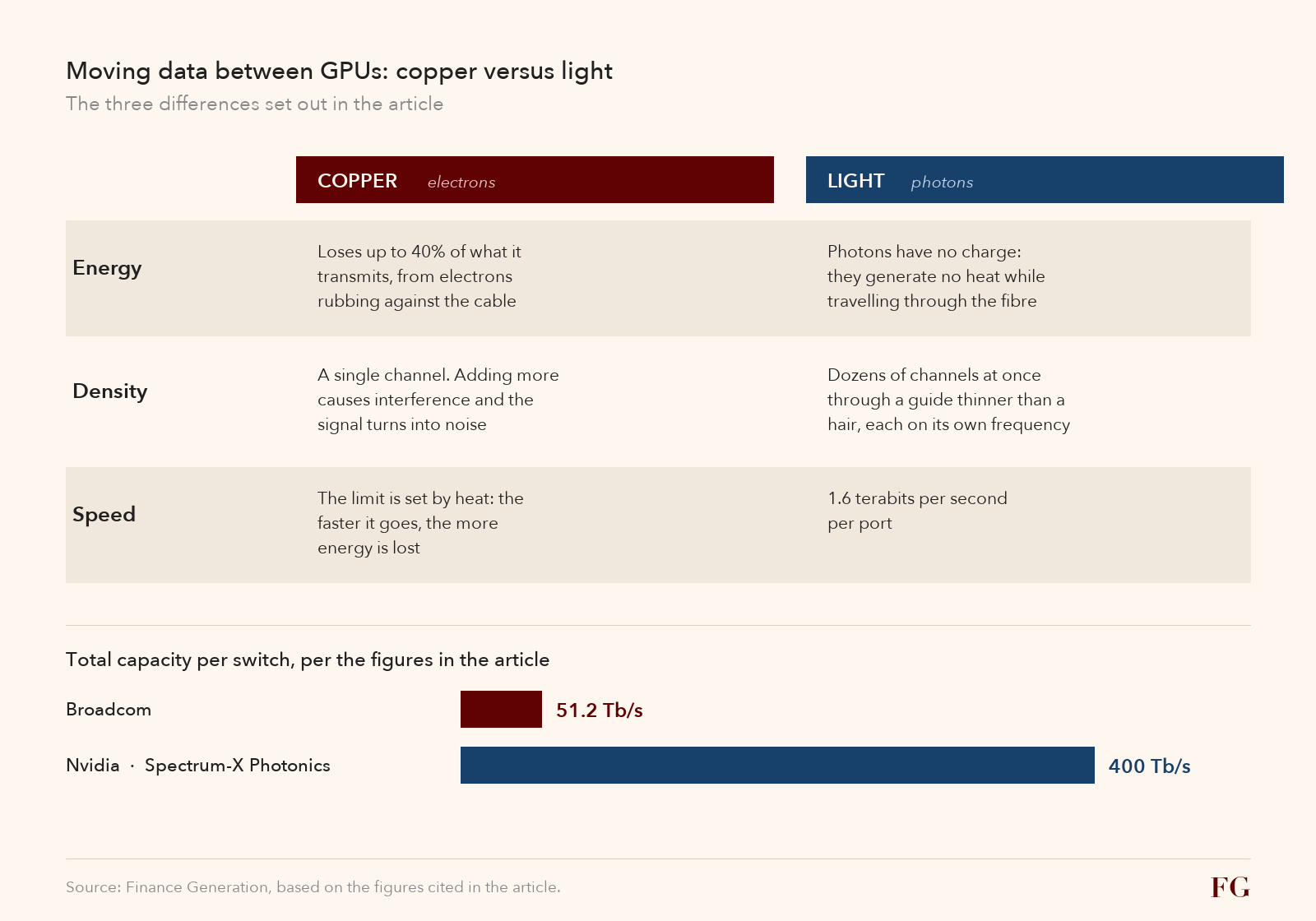
The first is energy efficiency. Photons have no electrical charge, so they do not generate heat as they travel through the fibre. Copper, on the other hand, can lose up to 40% of the energy it tries to transmit just from the friction of electrons against the cable itself.
The second is data density. Through a single waveguide, thinner than a hair, dozens of information channels can travel simultaneously, each encoded on a different frequency of light. It is similar to radio: you can have dozens of stations playing at the same time through the same air, each on its own frequency, without mixing or stepping on each other. With copper, trying something like this causes the well-known interference between signals, a bit like several stations overlapping on the same frequency. The result? Instead of hearing one clearly, you would end up hearing a confused noise of all of them mixed together.
With light, however, there is nothing to worry about; each “frequency” travels in its own lane without colliding with the others.
The third is speed. Nvidia’s new photonic switches, presented under the names Spectrum-X Photonics and Quantum-X Photonics, reach 1.6 terabits per second per port. To give you an idea of the scale: that is equivalent to moving the entire content of several streaming platforms in a matter of seconds, continuously and multiplied by each of the thousands of ports in a data centre.
Source: Finance Generation, based on the figures cited in the article.
From theory to reality
This is no longer a futuristic idea. Nvidia has confirmed that these photonic switches are part of its current networking infrastructure, designed so that more than 10,000 GPUs can communicate with each other without any of them having to wait its turn. It has also backed the bet with billions of dollars invested in suppliers such as Corning, Coherent and Lumentum to secure its supply of optical components.
Spain has not been left out either. The Government has awarded €62.1 million to ICFO (the Institute of Photonic Sciences), the Polytechnic University of Valencia, the National Microelectronics Centre and the University of Vigo to research and manufacture photonic chips, as part of a European photonics programme. On top of that, thanks to funding from the European Commission, which matches the Spanish contribution, the initiative will mobilise a total of €124.2 million.
Why it matters
The market has already put a price on this bet. When Nvidia confirmed its investments of $2,000 million in Lumentum and another $2,000 million in Coherent, shares in both rose on the same day. Lumentum, which makes the lasers and optical components that power these data centres, has gained more than 1,000% in value over the last year, largely thanks to its role as a key Nvidia supplier. Coherent, for its part, strung together quarters of record revenue even before the deal was closed, which points to strong demand.
Although everything seems to be going Nvidia’s way, it is not the only one playing this game. Broadcom, its great rival in custom chips, has spent years developing its own optical switches, with a total capacity of 51.2 terabits per second per switch; far below the 400 terabits per second that Nvidia promises with its Spectrum-X Photonics switches. Marvell is not lagging behind either: it has invested billions in acquisitions such as Celestial AI and has signed a silicon photonics collaboration agreement with Nvidia, although they continue to compete head to head on other fronts of the business.
And that, ultimately, is the real battle: the growth of AI no longer depends only on making more powerful chips, but on who first works out how to get them talking to each other. In this silent race for infrastructure, light has stopped being a laboratory curiosity and become the bet that may decide who keeps growing and who runs out of room.
Compártelo en tu historia
- Descarga la imagen.
- Súbela a tu historia de Instagram.
- Añade el sticker de enlace y pega el del artículo: ya lo tienes copiado.