UniCredit y Commerzbank: el precio de crear un gigante bancario europeo
Las fusiones bancarias en Europa llevan más de una década siendo una asignatura pendiente y el foco se ve hoy en Fráncfort. Andrea Orcel, consejero delegado del grupo italiano UniCredit, se ha propuesto tomar el control de Commerzbank, el segundo mayor banco de Alemania, motor financiero de sus empresas y referente del sector en el continente. La operación daría a Europa un gigante europeo con activos cercanos a los 1,4 billones de euros, aunque de momento topa con el rechazo tanto de la cúpula de la entidad germana como del Gobierno en Berlín. Superar los obstáculos regulatorios y políticos es solo el primer paso; ¿será capaz UniCredit de exprimir suficiente valor de la operación para compensar el desembolso, cumplir las sinergias prometidas y asumir los riesgos de integración?
De 2024 a 2026: cómo UniCredit se empezó a hacer con el control
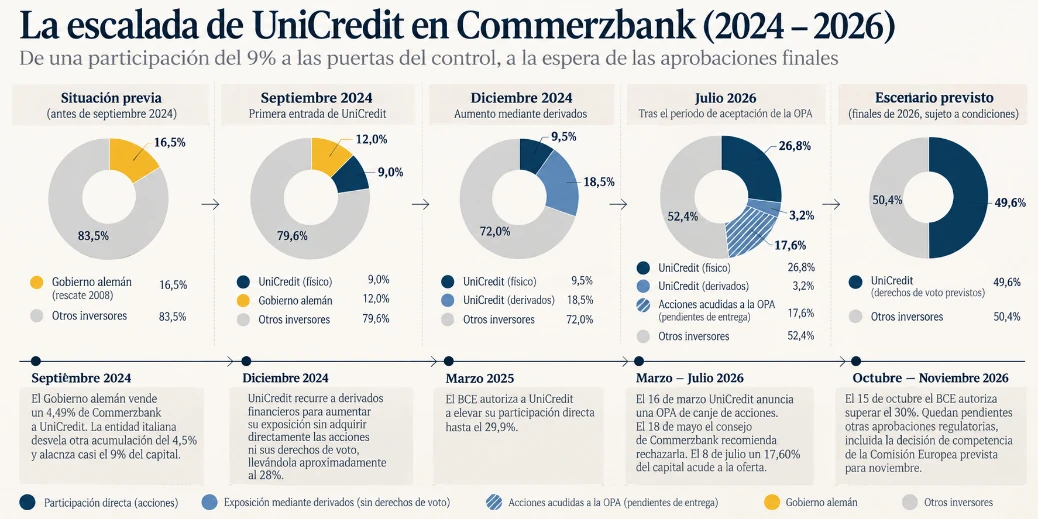
En septiembre de 2024, el Gobierno alemán puso a la venta un 4,49 % de su participación en Commerzbank, que todavía mantenía desde el rescate de 2008. Esta fue comprada íntegramente por UniCredit, que además desveló que había adquirido otro 4,5 % en el mercado, alcanzando así casi el 9 % del capital. Posteriormente, recurrió a derivados financieros para seguir aumentando su exposición sin adquirir directamente las acciones ni sus derechos de voto, llegando aproximadamente al 28 % en diciembre. En marzo de 2025, el BCE autorizó a UniCredit a elevar su participación directa hasta el 29,9 %.
El 16 de marzo de 2026, UniCredit anunció una OPA mediante un canje de acciones, ofreciendo 0,485 acciones propias por cada título de Commerzbank, lo que equivalía entonces a unos 30,80 € por acción. Sin embargo, el 18 de mayo el consejo de Commerzbank rechazó la oferta, al considerar que el precio era insuficiente y que las sinergias previstas no estaban suficientemente justificadas.
Finalmente, el 8 de julio UniCredit anunció que un 17,60 % adicional del capital había acudido a la OPA, elevando su posición potencial hasta el 47,59 %, aunque parte de esas acciones seguían pendientes de entrega. El 15 de octubre llegó la autorización del BCE para superar el 30 %, quedando todavía pendientes otras aprobaciones y condiciones regulatorias antes de poder ejercer el control.
El precio de la adquisición: ¿dónde está la prima de control?
Cuando se publicó oficialmente la OPA en mayo, la oferta equivalía a 31,07 euros por acción, mientras que las acciones de Commerzbank cotizaban a 34,02 euros. Es decir, UniCredit estaba ofreciendo un 8,7 % menos de lo que valían en bolsa. Aunque el canje de acciones no había cambiado, su valor dependía de cómo evolucionara la cotización de UniCredit en relación con la de Commerzbank.
Aquí entra en juego la prima de control, que es el sobreprecio que normalmente se paga por hacerse con el control de una empresa. En este caso, Commerzbank considera que la oferta no refleja su verdadero potencial y apuesta por seguir creciendo de forma independiente con su plan Momentum 2030. Por su parte, UniCredit defiende que la cotización de Commerzbank ya está por encima de lo que justifican sus resultados y que el banco necesita una transformación para mejorar su rentabilidad.
El descuento que presentaba la oferta en mayo deja una pregunta bastante clara: ¿qué ganan los accionistas de Commerzbank aceptando el canje? Si confían en que el banco puede mejorar sus resultados por su cuenta, tienen pocos incentivos para vender. Para aceptar tendrían que pensar que UniCredit puede sacar más partido al negocio y que eso se reflejará en el valor de sus acciones. El problema es que, de momento, la oferta les pide confiar en esa mejora sin ofrecer una prima de control atractiva.
Las sinergias: por qué la operación podría tener sentido financiero
UniCredit ya tiene una presencia importante en Alemania a través de HypoVereinsbank (HVB), por lo que la compra de Commerzbank le permitiría reforzar su posición en un mercado que ya conoce. Uno de los principales atractivos es la relación de Commerzbank con el Mittelstand, las medianas empresas alemanas. UniCredit podría aprovechar esta cartera de clientes para ofrecerles más servicios de financiación, coberturas y acceso a los mercados internacionales.
En cuanto a los costes, UniCredit presentó en abril su plan Commerzbank Unlocked, con el que calculaba conseguir unos ahorros anuales de 1.300 millones de euros para 2028 respecto a las previsiones del mercado. Estos vendrían principalmente de reducir gastos administrativos, simplificar estructuras y mejorar procesos mediante tecnología. Además, una futura integración con HVB permitiría eliminar funciones duplicadas y conseguir ahorros adicionales.
Según sus estimaciones, estas medidas permitirían reducir el Cost-to-Income de Commerzbank hasta cerca del 40 % y elevar su rentabilidad sobre el capital tangible (RoTE) por encima del 19 % en 2028. Eso sí, para poner en marcha el plan haría falta una inversión acumulada de unos 1.700 millones de euros.
Pero conseguir esos ahorros no será tan sencillo. UniCredit tendría que reorganizar procesos, asumir costes de reestructuración y evitar que parte de los clientes corporativos se marchen. Commerzbank, de hecho, considera que el banco italiano está infravalorando esos riesgos. Y aquí está una de las principales dudas de la operación: no es lo mismo anunciar 1.300 millones de ahorro al año que conseguirlos sin perder negocio por el camino.
¿Vale más Commerzbank independiente o bajo el control de UniCredit?
Por su cuenta, Commerzbank espera alcanzar un beneficio de 5.900 millones de euros en 2030, con un RoTE del 21 % y un Cost-to-Income del 43 %. Para conseguirlo, su plan Momentum 2030 apuesta por aumentar los ingresos procedentes del crédito y las comisiones, aprovechar el crecimiento de mBank y seguir invirtiendo en tecnología. Los resultados de 2026 muestran avances en esta dirección, aunque cumplir estos objetivos dependerá de que consiga controlar los gastos y aumentar los ingresos sin asumir demasiados riesgos.
Por otro lado, UniCredit estima que Commerzbank podría alcanzar unos 6.000 millones de beneficio y un RoTE cercano al 23 % en 2030. A primera vista, la diferencia no parece muy grande, pero hay que tener en cuenta que las previsiones de UniCredit son anteriores a Momentum 2030 y parten de supuestos distintos. Algo parecido ocurre con el Cost-to-Income: el 43 % previsto por Commerzbank incluye contribuciones obligatorias que, si se excluyen, reducirían la ratio al 41 %, frente al 37 % que calcula UniCredit.
Donde realmente aparecen las diferencias es en el coste de llevar a cabo esa transformación. UniCredit prevé perder unos 650 millones de euros de ingresos anuales al reducir los activos ponderados por riesgo, mientras que Commerzbank eleva esa cifra por encima de los 1.000 millones. También discrepan en la inversión necesaria: UniCredit calcula unos 3.400 millones de euros acumulados antes de impuestos, frente a los más de 4.200 millones que estima Commerzbank.
Además, muchas de las mejoras que plantea UniCredit, como digitalizar procesos o reducir gastos, también podría realizarlas Commerzbank por su cuenta. La principal ventaja de una adquisición estaría en integrar ambos bancos y eliminar duplicidades con HVB, aunque esto llevaría tiempo y podría provocar la pérdida de algunos clientes.
Ya no se trata solo de ver qué banco presenta mejores previsiones para 2030, sino de saber qué parte de esa mejora necesita realmente una adquisición. Si Commerzbank puede conseguir buena parte de los resultados por su cuenta, UniCredit tendría que justificar cuánto valor adicional aportaría la integración con HVB y si sería suficiente para compensar los costes y la posible pérdida de clientes.
Alemania se resiste: política, regulación y soberanía bancaria
La oposición alemana a la operación no responde únicamente a motivos económicos, sino también políticos. Commerzbank tiene un papel importante en la financiación del Mittelstand, las medianas empresas alemanas, y es una entidad relevante para el empleo y la economía de Fráncfort. Su consejera delegada, Bettina Orlopp, ha advertido de los riesgos de una posible reestructuración, mientras que el ministro Lars Klingbeil insiste en que deben protegerse los puestos de trabajo, la financiación a las empresas y la sede del banco. Aun así, desde septiembre el Gobierno alemán ha pasado de rechazar la operación a mostrarse dispuesto a negociar ciertas garantías.
Alemania todavía conserva alrededor del 13,3 % de Commerzbank, una participación que mantiene desde el rescate financiero de 2008-2009. Aunque el Gobierno tiene intereses tanto como accionista como por el peso del banco en la economía, su oposición no significa que pueda bloquear legalmente la operación.
En cuanto a los reguladores, a 27 de octubre el BCE ya había autorizado a UniCredit a superar el 30 % del capital y aumentar su participación sin límite, tras analizar la operación desde el punto de vista prudencial. Sin embargo, todavía faltaba la aprobación de la Comisión Europea, encargada de estudiar sus efectos sobre la competencia, cuyo plazo inicial terminaba el 16 de noviembre. Además, esta autorización no supone que una futura fusión con HVB esté automáticamente aprobada.
La operación también abre un debate más amplio sobre el sector bancario europeo. Mientras bancos estadounidenses como JPMorgan o Goldman Sachs operan a gran escala, Europa sigue teniendo un mercado bastante fragmentado. Una mayor concentración permitiría reducir costes y ganar tamaño, aunque eso no garantiza una mayor competitividad.
Alemania tiene razones para exigir garantías sobre el empleo, la financiación a sus empresas y la competencia. Otra cosa es rechazar la operación simplemente porque el comprador es italiano. Si Europa quiere un sector bancario más integrado, resulta difícil defender que una adquisición entre dos bancos europeos deba encontrar más obstáculos por una cuestión de nacionalidad que por sus efectos económicos.
El último paso
A 28 de octubre, el 16 de noviembre seguía siendo la fecha prevista para que la Comisión Europea se pronunciara sobre la operación desde el punto de vista de la competencia. Bruselas podría aprobarla, exigir ciertas condiciones o abrir una investigación más detallada. En cualquier caso, recibir su autorización sería un paso importante, pero no significaría que la adquisición estuviera completada.
Si se cumplen las condiciones pendientes y UniCredit recibe las acciones de la OPA y las relacionadas con sus derivados, podría llegar a controlar aproximadamente el 49,65 % de los derechos de voto de Commerzbank. El Estado alemán mantendría alrededor del 13,3 % del capital y el resto seguiría en manos de otros accionistas. Por tanto, no estaríamos hablando de una compra del 100 %, aunque esa participación podría ser suficiente para controlar muchas decisiones ordinarias, dependiendo de cuántos accionistas acudieran a las juntas. Para aprobar una fusión, en cambio, se necesitaría, como regla general, el respaldo del 75 % del capital representado.
A partir de ahí, UniCredit tendría varias opciones. Podría mantener Commerzbank como un banco independiente bajo su control o intentar una integración más profunda con HVB. Sin embargo, también podría encontrarse con retrasos por la oposición de accionistas minoritarios, las exigencias regulatorias o los costes de la integración.
También importa cuánto tarde UniCredit en conseguir los ahorros. Si tiene que asumir los costes de integración desde el principio, pero los beneficios llegan más tarde de lo previsto, la rentabilidad de la operación se reduce. Por eso, alcanzar el 49,65 % de los derechos de voto no resolvería todas las dudas. UniCredit estaría más cerca de controlar Commerzbank, pero todavía tendría que demostrar que comprarlo genera más valor que dejarlo crecer por su cuenta.
Bank mergers in Europe have been unfinished business for more than a decade, and today the spotlight is on Frankfurt. Andrea Orcel, chief executive of the Italian group UniCredit, has set out to take control of Commerzbank, Germany’s second-largest bank, a financial engine for its companies and a benchmark for the sector on the continent. The deal would give Europe a banking giant with assets of close to 1.4 trillion euros, although for now it has run into rejection from both the German lender’s leadership and the government in Berlin. Overcoming the regulatory and political obstacles is only the first step: will UniCredit be able to extract enough value from the deal to make up for the outlay, deliver the promised synergies and take on the integration risks?
From 2024 to 2026: how UniCredit began taking control
In September 2024, the German government put up for sale 4.49% of its stake in Commerzbank, which it had held since the 2008 bailout. The whole block was bought by UniCredit, which also revealed that it had acquired another 4.5% in the market, bringing it to almost 9% of the share capital. It then turned to financial derivatives to keep increasing its exposure without directly acquiring the shares or their voting rights, reaching approximately 28% in December. In March 2025, the ECB authorised UniCredit to raise its direct stake to as much as 29.9%.
On 16 March 2026, UniCredit announced a takeover bid through a share exchange, offering 0.485 of its own shares for each Commerzbank share, which at the time was equivalent to around €30.80 per share. However, on 18 May the Commerzbank board rejected the offer, considering the price insufficient and the expected synergies not sufficiently justified.
Finally, on 8 July UniCredit announced that an additional 17.60% of the share capital had been tendered into the offer, raising its potential position to 47.59%, although some of those shares were still pending delivery. On 15 October the ECB authorised it to exceed 30%, with other approvals and regulatory conditions still pending before it could exercise control.
The price of the acquisition: where is the control premium?
When the offer was officially published in May, it was equivalent to 31.07 euros per share, while Commerzbank shares were trading at 34.02 euros. In other words, UniCredit was offering 8.7% less than they were worth on the stock market. Although the exchange ratio had not changed, its value depended on how UniCredit’s share price performed relative to Commerzbank’s.
This is where the control premium comes into play: the extra price that is normally paid to take control of a company. In this case, Commerzbank considers that the offer does not reflect its true potential and is betting on continuing to grow independently with its Momentum 2030 plan. UniCredit, for its part, argues that Commerzbank’s share price is already above what its results justify and that the bank needs a transformation to improve its profitability.
The discount in the offer in May raises a fairly clear question: what do Commerzbank shareholders gain by accepting the exchange? If they trust that the bank can improve its results on its own, they have little incentive to sell. To accept, they would have to believe that UniCredit can get more out of the business and that this will be reflected in the value of their shares. The problem is that, for now, the offer asks them to trust in that improvement without offering an attractive control premium.
The synergies: why the deal could make financial sense
UniCredit already has a significant presence in Germany through HypoVereinsbank (HVB), so buying Commerzbank would allow it to strengthen its position in a market it already knows. One of the main attractions is Commerzbank’s relationship with the Mittelstand, Germany’s medium-sized companies. UniCredit could use this client base to offer them more financing, hedging and access to international markets.
On the cost side, in April UniCredit presented its Commerzbank Unlocked plan, with which it expected to achieve annual savings of 1,300 million euros by 2028 compared with market forecasts. These would come mainly from cutting administrative expenses, simplifying structures and improving processes through technology. In addition, a future integration with HVB would make it possible to eliminate duplicated functions and achieve further savings.
According to its estimates, these measures would bring Commerzbank’s cost-to-income ratio down to close to 40% and lift its return on tangible equity (RoTE) above 19% in 2028. That said, launching the plan would require a cumulative investment of around 1,700 million euros.
But achieving those savings will not be so simple. UniCredit would have to reorganise processes, take on restructuring costs and prevent some corporate clients from leaving. Commerzbank, in fact, believes that the Italian bank is underestimating those risks. And here lies one of the main doubts about the deal: announcing 1,300 million in annual savings is not the same as achieving them without losing business along the way.
Is Commerzbank worth more independent or under UniCredit’s control?
On its own, Commerzbank expects to reach a profit of 5,900 million euros in 2030, with a RoTE of 21% and a cost-to-income ratio of 43%. To get there, its Momentum 2030 plan relies on increasing income from lending and fees, taking advantage of mBank’s growth and continuing to invest in technology. The 2026 results show progress in this direction, although meeting these targets will depend on keeping costs under control and increasing income without taking on too much risk.
UniCredit, on the other hand, estimates that Commerzbank could reach a profit of around 6,000 million and a RoTE of close to 23% in 2030. At first glance, the difference does not seem very large, but it should be borne in mind that UniCredit’s forecasts predate Momentum 2030 and start from different assumptions. Something similar happens with the cost-to-income ratio: the 43% forecast by Commerzbank includes mandatory contributions which, if excluded, would lower the ratio to 41%, compared with the 37% calculated by UniCredit.
Where the differences really emerge is in the cost of carrying out that transformation. UniCredit expects to lose around 650 million euros in annual revenue by reducing risk-weighted assets, while Commerzbank puts that figure above 1,000 million. They also disagree on the investment required: UniCredit calculates around 3,400 million euros cumulatively before tax, compared with the more than 4,200 million estimated by Commerzbank.
Moreover, many of the improvements UniCredit proposes, such as digitalising processes or cutting costs, could also be carried out by Commerzbank on its own. The main advantage of an acquisition would lie in integrating the two banks and eliminating overlaps with HVB, although this would take time and could lead to the loss of some clients.
It is no longer just a question of which bank presents the better forecasts for 2030, but of knowing how much of that improvement actually requires an acquisition. If Commerzbank can achieve a good part of the results on its own, UniCredit would have to justify how much additional value the integration with HVB would bring and whether it would be enough to offset the costs and the possible loss of clients.
Germany resists: politics, regulation and banking sovereignty
German opposition to the deal is not driven solely by economic reasons, but also by political ones. Commerzbank plays an important role in financing the Mittelstand, Germany’s medium-sized companies, and is a significant institution for employment and the economy of Frankfurt. Its chief executive, Bettina Orlopp, has warned of the risks of a possible restructuring, while minister Lars Klingbeil insists that jobs, corporate financing and the bank’s headquarters must be protected. Even so, since September the German government has moved from rejecting the deal to showing a willingness to negotiate certain guarantees.
Germany still holds around 13.3% of Commerzbank, a stake it has kept since the 2008-2009 financial bailout. Although the government has interests both as a shareholder and because of the bank’s weight in the economy, its opposition does not mean that it can legally block the deal.
As for the regulators, as of 27 October the ECB had already authorised UniCredit to exceed 30% of the share capital and increase its stake without limit, after analysing the deal from a prudential point of view. However, approval was still pending from the European Commission, which is responsible for studying its effects on competition and whose initial deadline was 16 November. Moreover, this authorisation does not mean that a future merger with HVB is automatically approved.
The deal also opens a broader debate about the European banking sector. While US banks such as JPMorgan or Goldman Sachs operate at scale, Europe still has a fairly fragmented market. Greater concentration would make it possible to cut costs and gain size, although that does not guarantee greater competitiveness.
Germany has reasons to demand guarantees on employment, financing for its companies and competition. Rejecting the deal simply because the buyer is Italian is another matter. If Europe wants a more integrated banking sector, it is hard to argue that an acquisition between two European banks should face more obstacles because of nationality than because of its economic effects.
The final step
As of 28 October, 16 November was still the expected date for the European Commission to rule on the deal from a competition standpoint. Brussels could approve it, impose certain conditions or open a more detailed investigation. In any case, obtaining its authorisation would be an important step, but it would not mean that the acquisition was complete.
If the outstanding conditions are met and UniCredit receives the shares tendered into the offer and those linked to its derivatives, it could come to control approximately 49.65% of Commerzbank’s voting rights. The German state would keep around 13.3% of the share capital and the rest would remain in the hands of other shareholders. We would therefore not be talking about a 100% purchase, although that stake could be enough to control many ordinary decisions, depending on how many shareholders attended general meetings. Approving a merger, on the other hand, would as a general rule require the backing of 75% of the share capital represented.
From there, UniCredit would have several options. It could keep Commerzbank as an independent bank under its control or attempt a deeper integration with HVB. However, it could also run into delays because of opposition from minority shareholders, regulatory requirements or the costs of integration.
How long it takes UniCredit to achieve the savings also matters. If it has to bear the integration costs from the outset but the benefits arrive later than expected, the return on the deal shrinks. That is why reaching 49.65% of the voting rights would not settle every doubt. UniCredit would be closer to controlling Commerzbank, but it would still have to show that buying it creates more value than letting it grow on its own.
Compártelo en tu historia
- Descarga la imagen.
- Súbela a tu historia de Instagram.
- Añade el sticker de enlace y pega el del artículo: ya lo tienes copiado.