La deuda nunca muere, se renueva
Los gobiernos nunca terminan de pagar lo que deben: lo renuevan. Ahora que renovar sale más caro, alguien tiene que pagar la factura.
Si tienes una hipoteca a tipo variable, ya lo habrás notado. El euríbor, el índice al que va ligada, cerró septiembre con una media del 3,25%, su nivel más alto en dos años y más de un punto por encima del de hace doce meses. Pero esa subida no nace en tu banco. Nace en un sitio del que casi nunca se habla en la sobremesa: el mercado de tipos, donde también se fija el precio de la deuda pública.
Gobiernos que renuevan deuda constantemente
Cuando un gobierno necesita financiación, emite bonos y los vende en el mercado; a cambio, paga un interés a quien los compra. Hoy ese interés está en niveles que no se veían en décadas: el bono de Estados Unidos a treinta años rinde alrededor del 5,6%, lo más alto desde 2002, y el español a diez años ronda el 4,1%, cerca de su máximo del año. Detrás hay una inflación reavivada por el petróleo y la crisis de Ormuz, que ha llevado a los bancos centrales a subir los tipos: el Banco Central Europeo lo hizo el 10 de septiembre, su segunda subida del año tras la de junio, y la Reserva Federal, el día 16, por primera vez desde 2023.
Pero lo que está en juego va más allá de una subida de tipos. Los gobiernos nunca terminan de pagar su deuda: la renuevan. Cuando vence un bono, el Estado no tiene el dinero guardado y emite otro para devolverlo, y eso es lo habitual. Según la OCDE, el 78% de lo que pedirán prestado este año los gobiernos de sus países miembros servirá para refinanciar deuda existente, y las necesidades de refinanciación marcaron en 2025 un récord de 13,5 billones de dólares. La deuda pública mundial cerró 2025 en el 93,9% del PIB, es decir, de todo lo que produce el planeta en un año, y el Fondo Monetario Internacional (FMI) prevé que llegue al 100% en 2029, un nivel que solo se registró tras la Segunda Guerra Mundial.
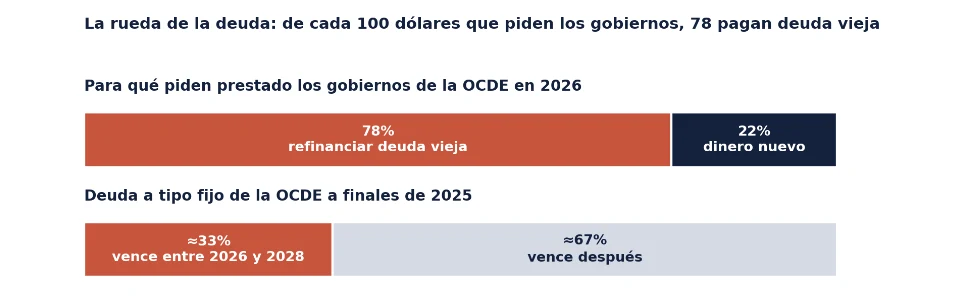
Fuente: OCDE, Global Debt Report 2026. El tercio de deuda a tipo fijo que vence entre 2026 y 2028 es la cifra que ofrece la OCDE; se muestra como ≈33%.
Este sistema ha funcionado mientras el dinero fue barato o hubo un banco central dispuesto a inyectar liquidez cuando el mercado se atragantaba. Eso está cambiando: ahora renovar sale mucho más caro.
Deuda vieja que vence a tipos más altos
El problema es que buena parte de lo que vence ahora se contrató cuando el dinero era barato. La OCDE calcula que un tercio de la deuda a tipo fijo de sus países vence entre 2026 y 2028, y los gobiernos acortan los plazos para pagar menos, lo que les obliga a refinanciar más a menudo. Estados Unidos es el caso mayor. Según la Oficina Presupuestaria del Congreso (CBO), su deuda ronda el 101% del PIB, su déficit, lo que gasta por encima de lo que ingresa, equivale al 5,8% de su economía, y solo en intereses pagará este año más de un billón de dólares, más de lo que gasta en defensa.
Para saber si esto es sostenible hay una cuenta sencilla: una deuda es manejable mientras la economía crece más deprisa que el interés que se paga por ella, como una hipoteca fija cuando tu sueldo sube más que la cuota. Hoy Estados Unidos paga de media un 3,5% por su deuda, porque buena parte se contrató cuando el dinero era barato, y su economía, sumando actividad real e inflación, creció en el segundo trimestre a un ritmo anualizado del 8,5% (un 2,2% real y un 6,1% de subida de precios), en parte inflada por el encarecimiento de la energía. Hay colchón, pero está hecho en buena medida de inflación, justo lo que los bancos centrales intentan frenar. Y la deuda barata vence y se renueva a los tipos de hoy: el 5,3% a diez años y el 5,6% a treinta.
Por eso ese colchón no garantiza nada. Más deuda vieja que renovar a tipos más altos significa más intereses; más intereses, más déficit; y más déficit, más deuda nueva que colocar. Cada vuelta sale más cara que la anterior. En Estados Unidos, los intereses absorberán este año casi uno de cada cinco dólares que recauda el Estado, y más de una cuarta parte en 2036, según la CBO. La renovación es gradual, porque la deuda tarda unos seis años de media en vencer, pero la dirección es clara: en un cálculo simplificado, renovar todo el saldo a los rendimientos actuales (en torno al 5% de media, frente al 3,5% que se paga hoy) costaría, sobre una deuda cercana al 100% del PIB, del orden de un punto y medio de PIB más al año en intereses. Y Washington sigue gastando más de lo que ingresa incluso sin contar los intereses.
Bancos centrales como comprador de último recurso
¿Quién comprará la deuda cuando el mercado no baste? La respuesta suele estar en los bancos centrales. En julio de 2012, en plena crisis bancaria y con dudas sobre la continuidad del euro, la prima de riesgo de España, el sobreprecio que exigen los inversores frente a Alemania, superó los 630 puntos básicos. La calma volvió cuando Mario Draghi prometió hacer «todo lo necesario» para salvar el euro, una promesa creíble porque había un banco central dispuesto a respaldarla. La Reserva Federal vivió la versión inversa: intentó reducir su balance, en octubre de 2025 anunció que lo frenaría por tensiones en la financiación y en diciembre volvió a comprar letras del Tesoro, oficialmente para mantener suficientes reservas en los bancos y no para financiar al Estado.
Esta red de seguridad tiene defensores, que sostienen que evita un colapso del mercado cuando nadie más compra, y críticos, que señalan tres costes:
Distorsiona el precio del dinero: cuando el banco central actúa como comprador principal, el tipo de interés deja de reflejar plenamente el riesgo real del emisor, y la confianza de los inversores pasa a depender de ese respaldo.
Amplía la desigualdad: si estas compras se prolongan en el tiempo, tienden a inflar el precio de los activos financieros, favoreciendo a quien ya tiene patrimonio frente al resto.
Crea dependencia y atrapa al banco central: esta es quizás la consecuencia más peligrosa a largo plazo. El mercado se acostumbra a la liquidez y, cuando el banco central intenta retirarla, el mercado se tensiona inmediatamente. Esto atrapa a la institución y, a la larga, compromete su independencia política frente al poder ejecutivo, convirtiéndola en el garante último de la financiación estatal.
Cuando los bancos centrales quedan atrapados en este bucle y a los Estados les queda menos holgura, el problema salta del plano monetario al político. ¿Cómo termina esta historia? La mejor guía es la historia. Un conocido estudio de Carmen Reinhart, Vincent Reinhart y Kenneth Rogoff sobre 70 episodios de reducción de deuda en 22 economías avanzadas desde 1800 concluye que los países ricos recurrieron, mucho más de lo que recordamos, a vías poco ortodoxas. Dejando aparte la solución ideal, crecer lo bastante deprisa como para diluir el problema, quedan tres salidas, y cada una la paga alguien distinto:
Recortar gasto y subir impuestos: lo paga el contribuyente, y tiene un coste político altísimo.
Dejar que la inflación se coma la deuda: una vía silenciosa cuyo coste recae sobre los ahorradores.
Reestructurar la deuda: una medida drástica que repercute en los acreedores.
La tentación de los gobiernos es la vía silenciosa: dejar que la inflación y los tipos reprimidos licúen la deuda. Pero ese atajo tiene un peaje que no figura en ningún presupuesto.
Inflación y represión de tipos como alternativa
No es la crisis de 1981-1982, cuando Paul Volcker llevó los tipos al 20% para frenar la inflación y asfixió a los países latinoamericanos endeudados en dólares. Hoy el riesgo se ha desplazado hacia economías ricas que se financian en monedas fuertes, y en ellas, antes del impago abierto, suelen aparecer otras vías, como esa inflación o esos tipos reprimidos. Lo habitual no es quebrar de golpe, sino ir cediendo margen de decisión. Quien rescata o financia suele imponer condiciones: lo vivió América Latina en los ochenta con los planes del FMI, Europa tras 2010 con los rescates y los recortes, y España con la reforma exprés de la Constitución de 2011, que puso el pago de la deuda por delante de cualquier otro gasto.
Y el mercado también puede vetar decisiones políticas, en cuestión de días. En septiembre de 2022, las rebajas fiscales sin financiar del gobierno británico de Liz Truss dispararon los tipos de interés, obligaron a una intervención de emergencia del Banco de Inglaterra y provocaron su dimisión a las siete semanas. Hoy el pulso se juega también en otro frente, el del Gobierno contra su propio banco central: el 16 de septiembre la Reserva Federal subió los tipos por unanimidad y, ese mismo día, Donald Trump reclamó en su red social tipos del 1% o menos. El dilema es de fondo: cuando financiar la deuda exige tipos bajos y frenar la inflación exige tipos altos, alguien tiene que ceder.
Nadie sabe si esta situación explotará, y quien ponga fecha solo especula. Los mercados tienen hoy más herramientas que en 1982 y los tipos oficiales están muy por debajo de los de entonces. Pero la historia, desde los ochenta hasta la crisis del euro, enseña que estos sistemas no se desploman por ser grandes, sino cuando los inversores dejan de creer que la rueda puede seguir girando en las condiciones de hoy, y ese cambio de opinión llega siempre más rápido que la reacción de los gobiernos. Por eso conviene vigilar tres señales: el interés que exigen los bonos a largo plazo, el momento en que los bancos centrales vuelvan a inyectar liquidez de emergencia para calmar al mercado y la velocidad con la que los Estados acortan los plazos de su deuda.
España no es ajena a esa rueda, aunque llega en mejor forma que hace una década. Su deuda bajó en julio al 99,9% del PIB, por debajo del 100% por primera vez desde febrero de 2020, y su prima de riesgo ronda los 50 puntos básicos, lejos de los más de 630 de 2012. El Tesoro ha alargado la vida media de la cartera hasta casi ocho años, de modo que solo renueva en torno al 13% cada ejercicio y paga de media cerca de un 2,3%, bastante menos que el 4,1% al que hoy se financia a diez años. Ese colchón se irá agotando a medida que la deuda vieja se renueve: los intereses superaron los 40.000 millones de euros en 2025 y el Gobierno prevé más de 42.000 este año. A esa factura se suma la del BCE, que subió los tipos en septiembre y no descarta hacerlo de nuevo.
Al final, la próxima vez que mires la cuota de tu hipoteca, recuerda que está conectada, por una cadena larga pero real, con esta rueda de deuda que no deja de girar. La pregunta de fondo ya no es si habrá que pagar la factura, sino quién la asumirá: el contribuyente, el ahorrador o el acreedor y, sobre todo, quién decidirá las reglas del juego.
If you have a variable-rate mortgage, you will already have noticed. The Euribor, the index it is tied to, ended September with an average of 3.25%, its highest level in two years and more than one point above where it stood twelve months ago. But that rise does not start at your bank. It starts somewhere that hardly ever comes up over the dinner table: the rates market, where the price of public debt is also set.
Governments that constantly roll over debt
When a government needs financing, it issues bonds and sells them on the market; in return, it pays interest to whoever buys them. Today that interest is at levels not seen in decades: the 30-year US bond yields around 5.6%, the highest since 2002, and the Spanish 10-year stands at around 4.1%, close to its high for the year. Behind this is inflation rekindled by oil and the Hormuz crisis, which has led central banks to raise rates: the European Central Bank did so on 10 September, its second rise of the year after June's, and the Federal Reserve on the 16th, for the first time since 2023.
But what is at stake goes beyond a rate rise. Governments never finish paying off their debt: they roll it over. When a bond matures, the state does not have the money set aside, so it issues another one to repay it, and that is the norm. According to the OECD, 78% of what the governments of its member countries will borrow this year will go to refinancing existing debt, and refinancing needs hit a record $13.5 trillion in 2025. Global public debt ended 2025 at 93.9% of GDP, that is, of everything the planet produces in a year, and the International Monetary Fund (IMF) expects it to reach 100% in 2029, a level only recorded after the Second World War.
Source: OECD, Global Debt Report 2026. The third of fixed-rate debt maturing between 2026 and 2028 is the figure given by the OECD; it is shown as ≈33%.
This system has worked as long as money was cheap or there was a central bank willing to inject liquidity when the market choked. That is changing: rolling over now costs much more.
Old debt maturing at higher rates
The problem is that much of what is maturing now was taken on when money was cheap. The OECD estimates that a third of its countries' fixed-rate debt matures between 2026 and 2028, and governments are shortening maturities to pay less, which forces them to refinance more often. The United States is the biggest case. According to the Congressional Budget Office (CBO), its debt stands at around 101% of GDP, its deficit, what it spends over and above what it takes in, is equivalent to 5.8% of its economy, and this year it will pay more than $1 trillion in interest alone, more than it spends on defence.
There is a simple calculation to tell whether this is sustainable: a debt is manageable as long as the economy grows faster than the interest paid on it, like a fixed-rate mortgage when your salary rises faster than the repayment. Today the United States pays an average of 3.5% on its debt, because much of it was taken on when money was cheap, and its economy, adding real activity and inflation together, grew in the second quarter at an annualised rate of 8.5% (2.2% in real terms and 6.1% from rising prices), partly inflated by more expensive energy. There is a cushion, but it is largely made of inflation, exactly what central banks are trying to curb. And the cheap debt matures and is rolled over at today's rates: 5.3% at ten years and 5.6% at thirty.
That is why the cushion guarantees nothing. More old debt to roll over at higher rates means more interest; more interest, a bigger deficit; and a bigger deficit, more new debt to place. Each turn costs more than the last. In the United States, interest will absorb almost one in every five dollars the state collects this year, and more than a quarter in 2036, according to the CBO. Rolling over is gradual, because the debt takes about six years on average to mature, but the direction is clear: in a simplified calculation, rolling over the entire stock at current yields (around 5% on average, compared with the 3.5% paid today) would cost, on a debt close to 100% of GDP, in the order of one and a half points of GDP more a year in interest. And Washington keeps spending more than it takes in even before counting interest.
Central banks as lender of last resort
Who will buy the debt when the market is not enough? The answer usually lies with central banks. In July 2012, in the middle of the banking crisis and with doubts over the survival of the euro, Spain's risk premium, the extra yield investors demand compared with Germany, rose above 630 basis points. Calm returned when Mario Draghi promised to do "whatever it takes" to save the euro, a credible promise because there was a central bank ready to back it. The Federal Reserve lived the reverse version: it tried to shrink its balance sheet, in October 2025 it announced it would halt that because of funding strains, and in December it started buying Treasury bills again, officially to keep enough reserves in the banks and not to finance the state.
This safety net has defenders, who argue that it prevents a market collapse when nobody else is buying, and critics, who point to three costs:
It distorts the price of money: when the central bank acts as the main buyer, the interest rate no longer fully reflects the issuer's real risk, and investor confidence comes to depend on that backing.
It widens inequality: if these purchases go on over time, they tend to inflate the price of financial assets, favouring those who already have wealth over everyone else.
It creates dependence and traps the central bank: this is perhaps the most dangerous long-term consequence. The market gets used to the liquidity and, when the central bank tries to withdraw it, the market immediately comes under strain. This traps the institution and, in the long run, compromises its political independence from the executive, turning it into the ultimate guarantor of state financing.
When central banks are trapped in this loop and states have less room for manoeuvre, the problem jumps from the monetary to the political sphere. How does this story end? The best guide is history. A well-known study by Carmen Reinhart, Vincent Reinhart and Kenneth Rogoff of 70 episodes of debt reduction in 22 advanced economies since 1800 concludes that rich countries resorted, far more than we remember, to unorthodox routes. Leaving aside the ideal solution, growing fast enough to dilute the problem, there are three ways out, and each one is paid for by someone different:
Cutting spending and raising taxes: the taxpayer pays, and the political cost is very high.
Letting inflation eat away the debt: a silent route whose cost falls on savers.
Restructuring the debt: a drastic measure that hits creditors.
The temptation for governments is the silent route: letting inflation and repressed rates melt the debt away. But that shortcut has a toll that appears in no budget.
Inflation and financial repression as alternative
This is not the 1981-1982 crisis, when Paul Volcker took rates to 20% to curb inflation and choked the Latin American countries that had borrowed in dollars. Today the risk has shifted towards rich economies that borrow in strong currencies, and in them, before an open default, other routes tend to appear, such as that inflation or those repressed rates. The usual outcome is not to go bankrupt overnight, but to gradually give up room for decision-making. Whoever rescues or finances usually imposes conditions: Latin America lived through it in the eighties with the IMF programmes, Europe after 2010 with the bailouts and cuts, and Spain with the fast-track 2011 reform of the Constitution, which put debt payments ahead of any other spending.
And the market can also veto political decisions, within days. In September 2022, the unfunded tax cuts of Liz Truss's British government sent interest rates soaring, forced an emergency intervention by the Bank of England and led to her resignation after seven weeks. Today the tug-of-war is also being played out on another front, that of the government against its own central bank: on 16 September the Federal Reserve raised rates unanimously and, that same day, Donald Trump called on his social network for rates of 1% or less. The dilemma runs deep: when financing the debt requires low rates and curbing inflation requires high rates, someone has to give way.
Nobody knows whether this situation will blow up, and anyone who puts a date on it is only speculating. Markets today have more tools than in 1982, and official rates are far below what they were then. But history, from the eighties to the euro crisis, teaches that these systems do not collapse because they are big, but when investors stop believing that the wheel can keep turning on today's terms, and that change of mind always comes faster than governments react. That is why three signals are worth watching: the interest demanded on long-term bonds, the moment central banks once again inject emergency liquidity to calm the market, and the speed at which states shorten the maturities of their debt.
Spain is no stranger to that wheel, although it arrives in better shape than a decade ago. Its debt fell in July to 99.9% of GDP, below 100% for the first time since February 2020, and its risk premium stands at around 50 basis points, far from the more than 630 of 2012. The Treasury has extended the average life of the portfolio to almost eight years, so it only rolls over around 13% each year and pays an average of about 2.3%, well below the 4.1% at which it borrows today at ten years. That cushion will wear thin as the old debt is rolled over: interest payments exceeded €40 billion in 2025 and the government expects more than €42 billion this year. On top of that bill comes the ECB's, which raised rates in September and does not rule out doing so again.
In the end, the next time you look at your mortgage payment, remember that it is connected, through a long but real chain, to this wheel of debt that never stops turning. The underlying question is no longer whether the bill will have to be paid, but who will pick it up: the taxpayer, the saver or the creditor and, above all, who will set the rules of the game.
Compártelo en tu historia
- Descarga la imagen.
- Súbela a tu historia de Instagram.
- Añade el sticker de enlace y pega el del artículo: ya lo tienes copiado.