SaaSpocalypse
El sector de software empresarial está experimentando su mayor caída en más de una década. Desde inicio de año, el índice IGV, (iShares Expanded Tech‑Software Sector ETF) replica un índice de compañías norteamericanas del sector software, ha caído un 20%, con empresas como Oracle (-20%), Salesforce (-20%) e Intuit (-30%) liderando las pérdidas. La capitalización bursátil destruida supera el billón de dólares, mientras que los fondos de cobertura han acumulado posiciones cortas históricas, generando 24.000 millones en beneficios. El catalizador: el temor a que plataformas de IA generativa como Claude, ChatGPT y Microsoft Copilot erosionen el modelo de negocio SaaS tradicional. Sin embargo, los indicadores técnicos sugieren un territorio de sobreventa extrema, con el RSI del IGV llegando a bajos históricos y ratios Put/Call en máximos anuales.
La pregunta crítica para inversores en el sector no es solo si habrá un rebote técnico, sino si esta corrección representa una oportunidad de entrada o la primera fase de una reestructuración sectorial permanente.
Los números demuestran una situación preocupante y es que el día 4 de febrero el RSI del IGV se desplomó hasta 14.18 puntos, alcanzando niveles de sobreventa no vistos desde mayo de 2006. Para inversores no familiarizados con análisis técnico: el RSI (Relative Strength Index) mide el momentum de precio en una escala de 0 a 100. Por debajo de 30 se considera sobreventa. Por debajo de 20 es capitulación.
Lo que estamos presenciando en esta primera semana de febrero no es una corrección cíclica, sino el inicio de lo que el mercado ya denomina el 'SaaSpocalypse'
La causa del desplome va mucho más allá de un mal trimestre en el sector o malos resultados, se debe al miedo sistémico sobre la viabilidad del negocio clásico de las SaaS en un mundo dominado por agentes de IA. La tesis de los fondos de cobertura es, si la IA autónoma puede ejecutar procesos complejos, el modelo de 'pago por asiento' (per-seat pricing) de gigantes como Salesforce o Intuit corre el riesgo de perder una gran cantidad de sus ingresos.
Debido a que estas empresas basan su negocio en la cantidad de gente que utiliza su SaaS, si un agente permite que 1 empleado haga el trabajo de 5, la empresa cliente ya no necesita 5 licencias, necesita 1, y el ingreso potencial cae, aunque el producto sea el mismo. Por eso, más que una caída ‘del software’, lo que el mercado está empezando a cuestionar es un modelo de monetización; y ahí es donde conviene separar entre software que vende datos, software que vende flujos de trabajo y software que actúa como plataforma.
Para interpretar esta corrección conviene ordenar el sector por modelo de negocio, porque la IA no afecta a todas las compañías de software por igual.
La primera categoría son las empresas cuyo activo principal son datos (información propia, difícil de replicar): su valor depende menos de la interfaz y más de la calidad y exclusividad de esos datos, que pueden ganar relevancia en un entorno donde los modelos necesitan fuentes fiables.
La segunda categoría es el SaaS de flujos de trabajo por usuario, el modelo clásico por ‘asiento’—, que es el más expuesto: si los agentes elevan la productividad y reducen la necesidad de humanos, sus ingresos se reducirían, aunque el producto siga siendo útil.
La tercera categoría agrupa a las compañías que actúan como plataforma: no dependen tanto de cuántas personas hacen clic, sino de integrar sistemas, automatizar procesos y desplegar capacidades a escala en entornos corporativos (permisos, seguridad, integraciones). En un mundo con más automatización, esta capa puede ganar importancia porque coordina el trabajo de personas, software y agentes.
Por eso, más que una caída del sector software en general, lo que el mercado está empezando a cuestionar es, sobre todo, la sostenibilidad del modelo de monetización por usuario y qué empresas tienen un ‘moat’ que siga siendo válido con agentes de IA.
Una vez entendida la lógica detrás de esta corrección, el foco pasa al flujo y al posicionamiento. En el arranque de año, el movimiento no lo ha liderado el inversor minorista, sino el dinero institucional, con un aumento claro de ventas en corto y estrategias de cobertura que han elevado la presión vendedora.
Es importante vigilar un volumen alto de ventas en corto, porque el riesgo ya no es solo que el activo siga cayendo. También aparece el riesgo de un fenómeno llamado ‘short squeeze’. En pocas palabras: cuando hay un alto volumen apostando a la baja y sale un catalizador positivo, el precio rebota y muchos cortos se ven obligados a cerrar para no seguir perdiendo. Cerrar un corto significa comprar acciones.
Ahí empieza el efecto dominó, esas compras empujan el precio hacia arriba, lo que fuerza a más cortos a cubrir y así sucesivamente. No es que el mercado se vuelva alcista, es que el posicionamiento crea compras forzadas que pueden convertirse en una subida exponencial.
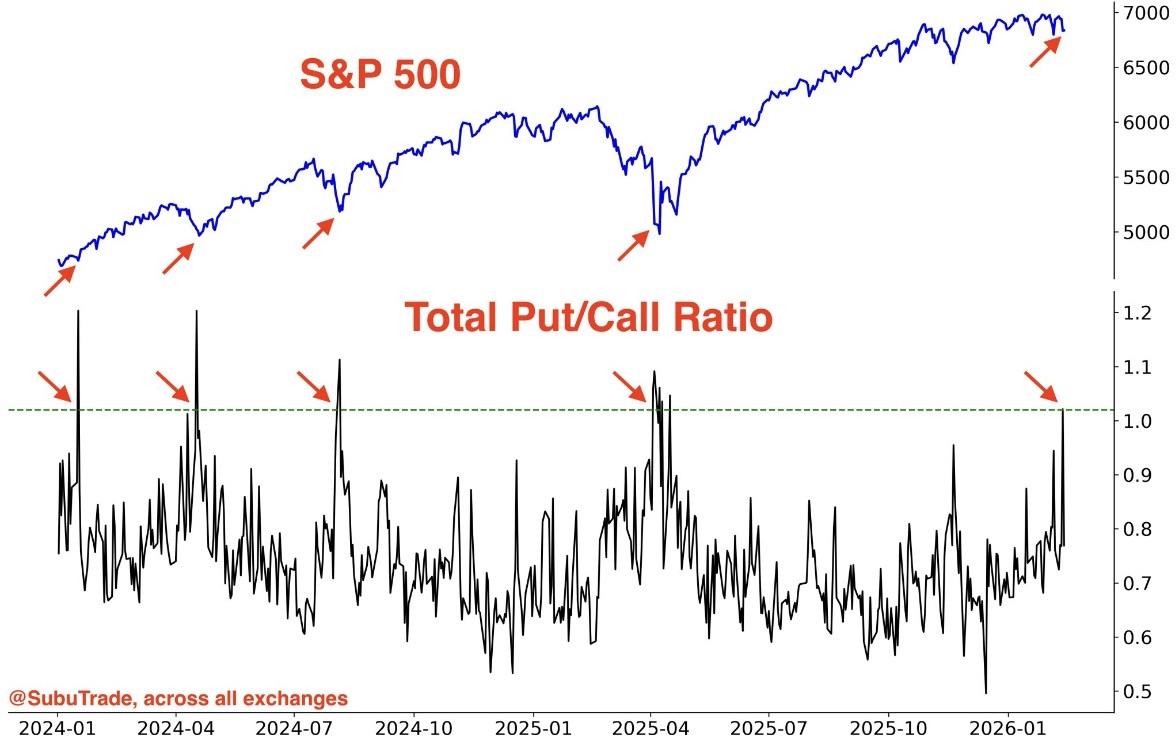
Para evaluar si el mercado está cerca de un suelo, conviene analizar el volumen, posicionamiento y ratio de las opciones. Históricamente el ratio Put/Call muestra un patrón de comportamiento que se está repitiendo en el inicio de este año. Como se observa en el gráfico, cada vez que este indicador se sitúa encima de 1, el mercado se encuentra con una cobertura defensiva extrema. También podemos ver que coincide con grandes caídas en los mercados, como, enero 2024, abril 2024, julio 2024 o abril 2025. Actualmente nos encontramos en 1.0, lo que refleja un posicionamiento defensivo elevado.
A partir de aquí, el mercado se enfrenta a dos potenciales caminos.
En primer lugar (Bull case), un rebote técnico. La caída ha sido tan concentrada que el sector puede estar cerca de un punto de agotamiento. Si el volumen vendedor se modera o los próximos resultados no son tan negativos como se temen, el precio puede rebotar con rapidez. En ese contexto, podría causar el fénomeno 'short squeeze', que he descrito antes, con cierres de posiciones cortas que podrían causar subidas exponenciales.
En segundo lugar (bear case), la corrección podría estar reflejando un ajuste bursátil más profundo: un cambio de reglas en el negocio del software. Dado que los agentes de IA están asumiendo una cargay eficiencia laboral superior a capacidad humana individual, el modelo de licencias por usuario está perdiendo su sentido económico, resultando en que, a las compañías les costará más defender precios y mantener el ritmo de crecimiento. En ese escenario puede haber rebotes, pero la recuperación sería más lenta y tendría que demostrar crecimiento para volver a cotizar en múltiplos previos.
Lo que viene ahora no es un debate sobre si el software rebota o se rompe, sino sobre si el sector aprende a cobrar en un mundo donde la productividad ya no se mide en empleados, sino en tareas resueltas. Porque cuando la IA cambia la unidad de valor, el mercado no ajusta el precio: ajusta el guion. Y en ese guion, algunos se adaptarán; otros se quedarán defendiendo un modelo que ya no marca el ritmo.
The enterprise software sector is experiencing its biggest decline in more than a decade. Since the beginning of the year, the IGV index (iShares Expanded Tech-Software Sector ETF), which tracks an index of US software companies, has fallen 20%, with companies such as Oracle (-20%), Salesforce (-20%), and Intuit (-30%) leading the losses. The market capitalization destroyed exceeds $1 trillion, while hedge funds have accumulated historic short positions, generating $24 billion in profits. The catalyst: fears that generative AI platforms such as Claude, ChatGPT, and Microsoft Copilot will erode the traditional SaaS business model. However, technical indicators suggest extremely oversold territory, with the IGV's RSI reaching historic lows and put/call ratios at annual highs.
The critical question for investors in the sector is not only whether there will be a technical rebound, but whether this correction represents an entry opportunity or the first phase of a permanent sector restructuring.
The numbers paint a worrying picture: on February 4, the IGV's RSI plummeted to 14.18 points, reaching oversold levels not seen since May 2006. For investors unfamiliar with technical analysis: the RSI (Relative Strength Index) measures price momentum on a scale of 0 to 100. Below 30 is considered oversold. Below 20 is capitulation.
What we are witnessing in this first week of February is not a cyclical correction, but the beginning of what the market is already calling the ‘SaaSpocalypse’.
The cause of the crash goes far beyond a bad quarter in the sector or poor results; it is due to systemic fear about the viability of the classic SaaS business in a world dominated by AI agents. The hedge funds' thesis is that if autonomous AI can execute complex processes, the per-seat pricing model of giants such as Salesforce and Intuit risks losing a large amount of their revenue.
Because these companies base their business on the number of people who use their SaaS, if an agent allows one employee to do the work of five, the client company no longer needs five licenses, it needs one, and potential revenue falls, even though the product is the same. Therefore, rather than a decline in “software,” what the market is beginning to question is a monetization model; and that is where it is important to distinguish between software that sells data, software that sells workflows, and software that acts as a platform.
To interpret this correction, it is useful to organize the sector by business model, because AI does not affect all software companies equally.
The first category is companies whose main asset is data (their own information, which is difficult to replicate): their value depends less on the interface and more on the quality and exclusivity of that data, which can gain relevance in an environment where models need reliable sources.
The second category is user-based workflow SaaS, the classic “seat” model, which is the most exposed: if agents increase productivity and reduce the need for humans, their revenues will decline, even if the product remains useful.
The third category includes companies that act as platforms: they do not depend so much on how many people click, but rather on integrating systems, automating processes, and deploying capabilities at scale in corporate environments (permissions, security, integrations). In a world with more automation, this layer may gain importance because it coordinates the work of people, software, and agents.
Therefore, rather than a decline in the software sector in general, what the market is beginning to question is, above all, the sustainability of the per-user monetization model and which companies have a moat that remains valid with AI agents.
Once the logic behind this correction is understood, the focus shifts to flow and positioning. At the start of the year, the movement has not been led by retail investors, but rather by institutional money, with a clear increase in short selling and hedging strategies that have increased selling pressure.
It is important to monitor high short selling volume, because the risk is no longer just that the asset will continue to fall. There is also the risk of a phenomenon called a “short squeeze.” In short, when there is a high-volume betting on a decline and a positive catalyst emerges, the price rebounds and many shorts are forced to close out their positions to avoid further losses. Closing a short position means buying shares.
That's where the domino effect begins: those purchases push the price up, forcing more shorts to cover, and so on. It's not that the market becomes bullish, it's that positioning creates forced purchases that can turn into an exponential rise.
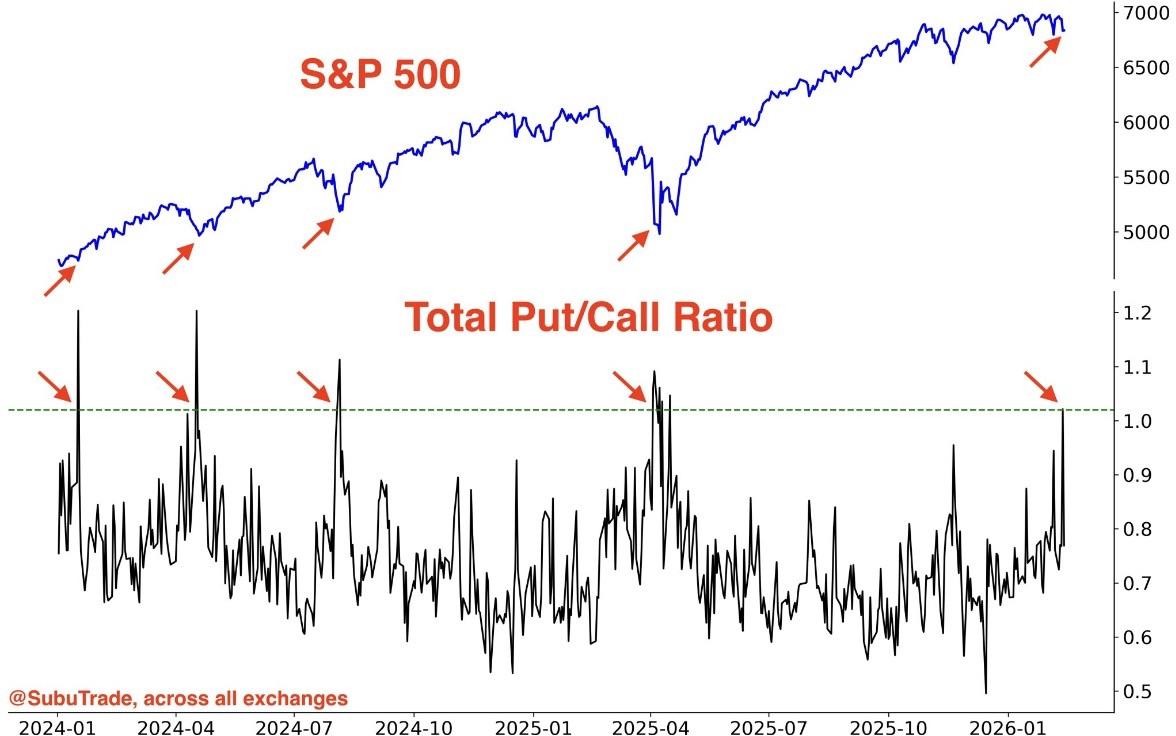
To assess whether the market is close to a bottom, it is advisable to analyze the volume, positioning, and ratio of options. Historically, the put/call ratio shows a pattern of behavior that is repeating itself at the beginning of this year. As can be seen in the chart, every time this indicator rises above 1, the market encounters extreme defensive coverage. We can also see that this coincides with major market declines, such as in January 2024, April 2024, July 2024, and April 2025. We are currently at 1.0, reflecting a high defensive positioning.
From here, the market faces two potential paths.
First (bull case), a technical rebound. The decline has been so concentrated that the sector may be close to a point of exhaustion. If selling volume moderates or upcoming results are not as negative as feared, the price may rebound quickly. In that context, it could cause the ‘short squeeze’ phenomenon I described earlier, with short positions being closed out, which could cause exponential rises.
Secondly (bear case), the correction could be reflecting a deeper stock market adjustment: a change in the rules of the software business. Given that AI agents are taking on a workload and efficiency superior to individual human capacity, the per-user licensing model is losing its economic sense, resulting in companies finding it more difficult to defend prices and maintain their growth rate. In this scenario, there may be rebounds, but recovery would be slower and would have to demonstrate growth to return to previous multiples.
What comes next is not a debate about whether software rebounds or breaks down, but whether the sector learns to charge in a world where productivity is no longer measured in employees, but in tasks completed. Because when AI changes the unit of value, the market does not adjust the price: it adjusts the script. And in that script, some will adapt; others will remain defending a model that no longer sets the pace.