Corporate M&A, el as bajo la manga
Bienvenidos a Corporate M&A
Antes de adentrarme en el Corporate M&A, querría agradecer al equipo de Finance Generation NextGen Voices por otro año más, por saber mantenernos enganchados, por hacer una estructura donde ganan tanto el lector como el escritor, y por seguir creciendo a pasos de hormiga que se sienten como pasos de elefante (ya que siempre lo suelen ser).
Esta vez, me gustaría explicar y hacer entender el M&A del mundo corporativo, con un claro ejemplo como Google y sus resultados, que no dejan indiferente a nadie.
Cuando pensamos en M&A, automáticamente pensamos en Goldman Sachs, Morgan Stanley, Lazard o Evercore. En los bancos que asesoran una transacción, construyen la valoración, organizan el proceso y ayudan a sentar al comprador y al vendedor en la misma mesa.
Pero alguien tiene que estar al otro lado de esa mesa.
Dentro de Google, Disney, Microsoft, Meta o cualquier gran compañía existe un equipo cuya función no es asesorar a otras empresas sobre qué deberían comprar. Su función es decidir qué debería comprar la suya.
Ese es el mundo del Corporate M&A.
Como estudiantes y profesionales, solemos ver solo una cara de la moneda, ese M&A Advisory de las firmas grandes mundiales y regionales que, digamos, tenemos al lado. Hoy quiero enseñar el otro lado de la moneda, ese lado que es igual de apasionante y al cual uno puede saltar después de pasar por Advisory o directamente hacer carrera en la propia empresa. Bienvenidos a Corporate M&A.
Pongámonos en el caso de Google, el cual ilustraré más adelante, para pensar como el equipo interno de Corporate M&A (también conocido como Corporate Development). Dentro de estos equipos el razonamiento se basa en tres posibles caminos: build, buy or partner. Pensando en el horizonte temporal de la compañía y los siguientes pasos que quiere dar, el equipo de Corporate deberá decidir qué estrategia seguir.
Build: Google construye una herramienta de vídeos donde poder hacer comunidades y sacar rédito con anuncios.
Partner: Google decide hacer un acuerdo con una compañía existente de vídeos para así ahorrar costes e ir de la mano.
Buy: Google puede comprar la empresa, gestionarla o no según las condiciones de la compra, e integrarla en su desarrollo corporativo. He aquí YouTube.
Antes de estas decisiones, todo el equipo habría hecho el trabajo de buscar targets, valorarlos, negociar, coordinar advisors, y muy importante, vivir con las consecuencias en el caso de salir positiva la operación de su decisión.
Un banker puede cerrar el deal y pasar al siguiente.
El corporate development team sigue dentro cuando hay que demostrar que aquello que compraron tenía sentido.
Es importante recalcar que no todas las adquisiciones persiguen lo mismo. Por ello, hay distintos tipos:
Horizontal
Comprar un negocio que opera aproximadamente en el mismo nivel de la cadena de valor. Motivaciones:
ganar cuota,
consolidar mercado,
adquirir usuarios,
eliminar duplicidades,
conseguir escala.
Vertical
Comprar un negocio situado “arriba” o “abajo” en la cadena de valor. Objetivo:
controlar distribución,
controlar proveedores,
integrar tecnología,
proteger márgenes,
reducir dependencias.
Adyacente / capability acquisition
Esta es especialmente importante en tecnología, ya que no estoy comprando necesariamente un competidor. Estoy comprando:
tecnología,
talento,
IP,
datos,
acceso a un mercado,
una capacidad que me falta.
A veces ni siquiera se busca comprar lo anterior, al ser muchas veces las personas del target el activo más valioso de este.
Adentrémonos entonces en el maravilloso imperio de Google.
Fuente: fourweekmba.com
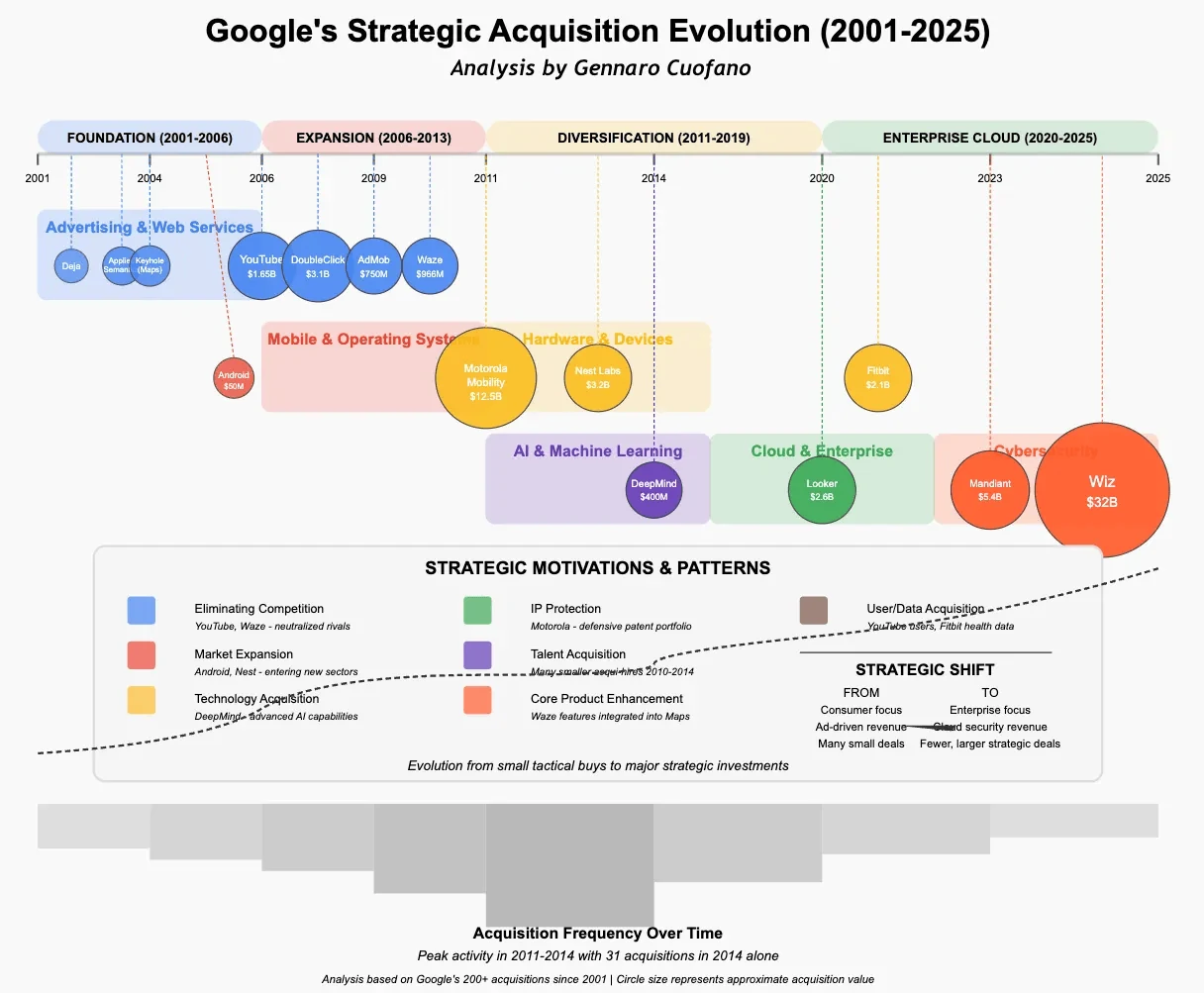
Este gráfico muestra las distintas adquisiciones de Google por tamaño y fecha en las últimas dos décadas y podemos identificar varios nombres cotidianos como YouTube, Android o Waze. Es importante recalcar que no todas las operaciones terminan funcionando como inicialmente se imaginan, y siguiendo un poco los principios del venture capital, corporate development no consiste en acertar el 100% de las veces, pero con un “unicornio” la estrategia de la empresa y los resultados demostrarán ellos solos.
Fuente: 10kreader
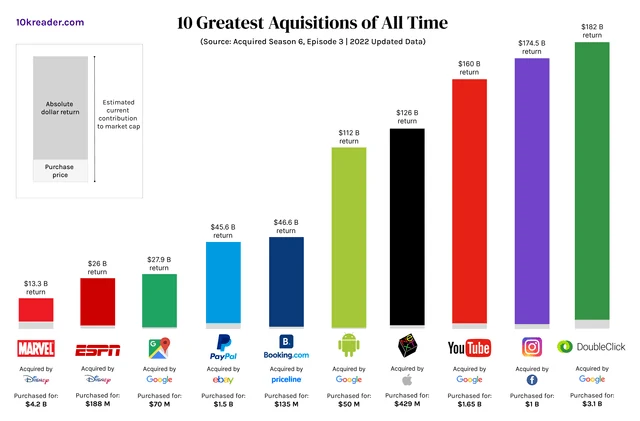
El verdadero as bajo la manga es el portfolio estratégico de apuestas y lo anteriormente mencionado, el cómo una sola adquisición extraordinaria, i.e., DoubleClick, puede pagar muchos experimentos que no funcionan.
Durante años, Corporate Development se ha presentado muchas veces como una de las salidas naturales tras unos años en Investment Banking. Y lo sigue siendo: las habilidades adquiridas en M&A advisory —valoración, modelización, ejecución, negociación y exposición a procesos— son extremadamente transferibles.
Pero reducir Corporate Development a una “exit opportunity” sería quedarse corto. Existen equipos donde jóvenes profesionales comienzan directamente y desarrollan desde el principio una combinación diferente: menos asesoramiento externo y más estrategia interna.
El mejor Corporate M&A posiblemente sea el que años después parece inevitable. Hoy resulta difícil imaginar Google sin YouTube, Android o DeepMind; del mismo modo que cuesta imaginar Disney sin Pixar, Marvel o Lucasfilm.
Pero ninguno de esos activos nació dentro de las compañías que hoy asociamos con ellos.
En ocasiones crecer significa ejecutar mejor aquello que ya haces. En otras palabras, significa reconocer que alguien fuera de tu organización ya ha construido la pieza que necesitas.
Saber distinguir ambas situaciones, cuándo construir y cuándo comprar, es precisamente el as bajo la manga del Corporate M&A.
Before diving into Corporate M&A, I would like to thank the Finance Generation NextGen Voices team for another year, for keeping us engaged, for building a structure where both readers and writers win, and for continuing to grow at an ant's pace that feels like an elephant's stride (as they usually do).
This time, I would like to explain and help understand M&A in the corporate world, with a clear example such as Google and its results, which leave no one indifferent.
When we think of M&A, we automatically think of Goldman Sachs, Morgan Stanley, Lazard or Evercore. The banks that advise a transaction, build the valuation, organize the process and help bring the buyer and seller to the same table.
But someone has to be on the other side of that table.
Within Google, Disney, Microsoft, Meta or any large company there is a team whose function is not to advise other companies on what they should buy. Their function is to decide what their own company should buy.
That is the world of Corporate M&A.
As students and professionals, we usually see only one side of the coin, that M&A Advisory of the large world and regional firms that, let's say, we have nearby. Today I want to show you the other side of the coin, that side that is equally exciting and which one can move to after spending time in Advisory or directly build a career within the company itself. Welcome to Corporate M&A.
Let's put ourselves in the case of Google, which I will illustrate later, to think like the internal Corporate M&A team (also known as Corporate Development). Within these teams, the reasoning is based on three possible paths: build, buy or partner. Thinking about the company's time horizon and the next steps it wants to take, the Corporate team must decide which strategy to follow.
Build: Google builds a video tool where it can build communities and generate revenue through ads.
Partner: Google decides to make an agreement with an existing video company to save costs and move forward hand in hand.
Buy: Google can buy the company, manage it or not depending on the conditions of the purchase, and integrate it into its corporate development. Enter YouTube.
Before these decisions, the entire team would have done the work of searching for targets, valuing them, negotiating, coordinating advisors, and very importantly, living with the consequences if the operation turned out positively from their decision.
A banker can close the deal and move to the next one.
The corporate development team stays on when it has to prove that what they bought made sense.
It is important to note that not all acquisitions pursue the same thing. Therefore, there are different types:
Horizontal
Buying a business that operates at approximately the same level of the value chain. Motivations:
gain market share,
consolidate the market,
acquire users,
eliminate duplicates,
achieve scale.
Vertical
Buying a business located "above" or "below" in the value chain. Objective:
control distribution,
control suppliers,
integrate technology,
protect margins,
reduce dependencies.
Adjacent / capability acquisition
This is especially important in technology, since I am not necessarily buying a competitor. I am buying:
technology,
talent,
IP,
data,
access to a market,
a capability I lack.
Sometimes we are not even looking to buy any of the above, as the target's people are often the most valuable asset in this.
Let us then venture into the wonderful empire of Google.
Source: fourweekmba.com
This chart shows Google's various acquisitions by size and date over the past two decades and we can identify several everyday names such as YouTube, Android or Waze. It is important to note that not all operations end up working as initially imagined, and following some venture capital principles, corporate development is not about getting it right 100% of the time, but with a "unicorn" the company's strategy and results will speak for themselves.
Source: 10kreader
The true trump card is the strategic portfolio of bets and what was mentioned earlier, how a single extraordinary acquisition, i.e., DoubleClick, can pay for many experiments that don't work.
For years, Corporate Development has often presented itself as one of the natural exits after a few years in Investment Banking. And it continues to be: the skills acquired in M&A advisory —valuation, modeling, execution, negotiation and exposure to processes— are extremely transferable.
But reducing Corporate Development to an "exit opportunity" would be selling it short. There are teams where young professionals start directly and develop from the beginning a different combination: less external advice and more internal strategy.
The best Corporate M&A is perhaps that which years later seems inevitable. Today it is difficult to imagine Google without YouTube, Android or DeepMind; just as it is hard to imagine Disney without Pixar, Marvel or Lucasfilm.
But none of those assets were born within the companies we associate them with today.
Sometimes growing means executing better what you already do. In other words, it means recognizing that someone outside your organization has already built the piece you need.
Knowing how to distinguish between both situations, when to build and when to buy, is precisely the trump card of Corporate M&A.